
The Safest Baby Carrier Holds Hips in an M, Not the Legs Dangling Straight
Narrow-based carriers leave legs hanging straight. Wide-based ones support the knees above the bottom. Plus the airway checks that matter.

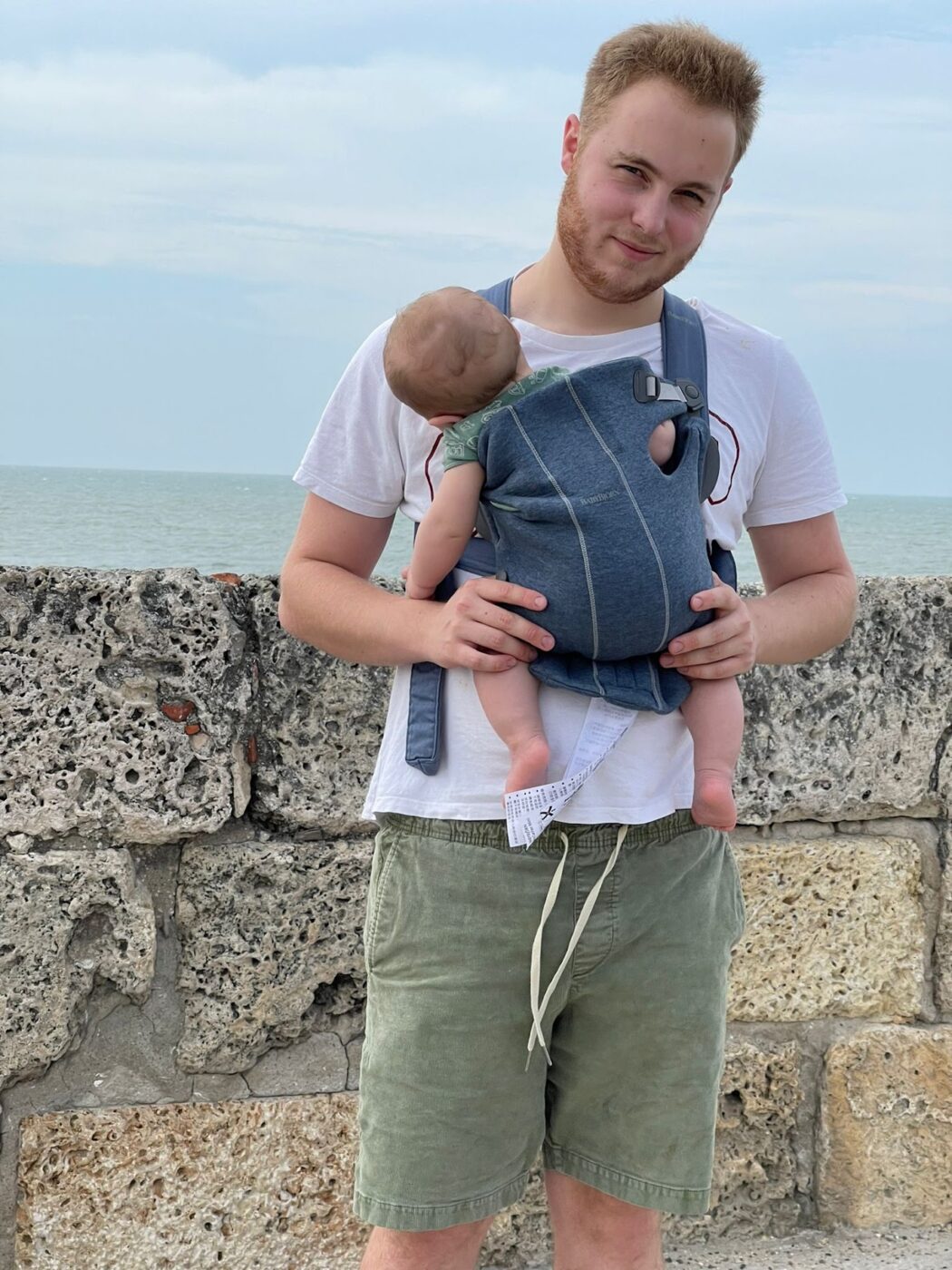
Babywearing is widely encouraged — carried babies are settled and parents keep their hands free.
Carriers differ in one structural way that is easy to overlook, and there is one set of airway checks worth making every single time.
Fear Index · Think twice
Two safety questions hidden inside a comfort purchase
Positioning affects hip development, and incorrect upright positioning of very young babies can compromise breathing. Both are checkable in seconds.
What an M position means
The International Hip Dysplasia Institute describes a healthy position for carried babies as the thighs spread around the parent’s body, supported from knee to knee, with the knees higher than the bottom — an M shape seen from the front.
That position keeps the ball of the hip seated in the socket. A narrow-based carrier supports only the crotch and lets the legs dangle straight down, which the Institute advises against for prolonged periods.
The practical test: look at the seat panel. It should reach from knee to knee. If the baby’s thighs hang off the edge from mid-thigh, the base is too narrow.
Many carriers have adjustable seat width. A panel that fits a newborn knee to knee needs widening as the baby grows, or the support ends at mid-thigh.
The airway checks that matter more

Positioning for hips is about development. Positioning for the airway is about immediate safety, particularly for young babies without head control.
The widely used TICKS checklist covers it:
- Tight. Snug enough that the baby is held close, not slumping.
- In view at all times. You can see the baby’s face by looking down.
- Close enough to kiss. The top of the head is near your chin.
- Keep chin off the chest. A chin pressed down can restrict breathing — about a finger’s width of space.
- Supported back. The baby’s back is supported in its natural position, tummy and chest against you.
Facing out, and which carrier type
Facing outwards is popular with older babies who want to see the world. It is generally advised only once a baby has good head and neck control, and for shorter periods, because it offers less support and more stimulation.
Stretchy wraps are snug and newborn-friendly and take practice to tie. Soft structured carriers with buckles are quicker and spread weight better for longer walks. Ring slings are fast for short carries and load one shoulder. The CPSC has warned that sling-style carriers pose a suffocation risk for babies under four months, especially those born prematurely, with a low birth weight or with a cold; check with a pediatrician before using one for a baby in those groups, and never let fabric cover the face.
Many communities have babywearing groups or lending libraries where you can try types with guidance before buying — which suits a purchase so dependent on fit.
Weight limits and everyday safety habits
Every carrier lists a minimum and maximum weight or age. A baby below the minimum may not be supported correctly even with the seat narrowed, and one above the maximum stresses seams and buckles the carrier was not built for.
Buckles and waist belts should click audibly and resist a firm tug before you rely on them. Check the stitching at the leg openings and shoulder straps occasionally, since that is where a structured carrier takes the most load.
Babywearing while cooking, driving or cycling adds the activity’s own risks to the carrier’s — a hot pan or a fall lands on a baby who cannot move out of the way. Most manufacturers advise against all three.
Register a new carrier with the manufacturer and check the model against recalls at cpsc.gov/Recalls occasionally; buckle and strap failures are the most common reason carriers get recalled.
The shortlist
Paid links: we earn a commission if you buy through the buttons below, at no extra cost to you. As an Amazon Associate I earn from qualifying purchases.
Compared on positioning
| Product type | Best for | Risk estimate | Where to buy |
|---|---|---|---|
| Soft Structured Baby Carrier (Wide Seat) | Longer walks and everyday use | 26/100 | See listings on AmazonOpens Amazon search results, not one listing: check the model on the product page. |
| Stretchy Baby Wrap | Newborns | 30/100 | See listings on AmazonOpens Amazon search results, not one listing: check the model on the product page. |
| Ring Sling | Short, quick carries | 38/100 | See listings on AmazonOpens Amazon search results, not one listing: check the model on the product page. |
Risk estimate is our editorial Fear Index for the product type (lower is safer), not a customer rating. How it is scored.
Soft Structured Baby Carrier (Wide Seat)
Check the panel reaches knee to knee at your baby’s current size, and widen it as they grow.
- Wide adjustable seat supports an M position
- Buckles are quick to put on
- Spreads weight for longer walks
- Bulky to pack
- Newborn fit may need an insert or adjustment
Stretchy Baby Wrap
Close and supportive for the smallest babies. Run through the TICKS checks every time you tie it.
- Very snug and close
- Adapts to any small baby
- Inexpensive
- Takes practice to tie
- Warm in hot weather
More: Baby & Kids analyses and how the Fear Index is scored.
Questions people actually ask
What is the M position in a baby carrier?
The baby’s thighs are spread and supported from knee to knee, with knees higher than the bottom. The International Hip Dysplasia Institute describes it as a hip-healthy carrying position.
Are narrow-based baby carriers bad for hips?
They leave the legs hanging straight down, a position the Institute advises against for prolonged periods. A wide seat that supports to the knees is preferred.
What is the TICKS rule for babywearing?
Tight, In view at all times, Close enough to kiss, Keep chin off the chest, Supported back. It covers the positioning checks that protect a baby’s airway.
When can a baby face out in a carrier?
Generally once they have good head and neck control, and for shorter periods. Facing inwards offers more support and less overstimulation.