
A Betta in a One-Gallon Bowl Lives in Ammonia Its Water Cannot Dilute
A betta releases ammonia into the water nonstop, and a bowl has no filter to process it. What veterinary and extension sources say about cycling, size and heat.

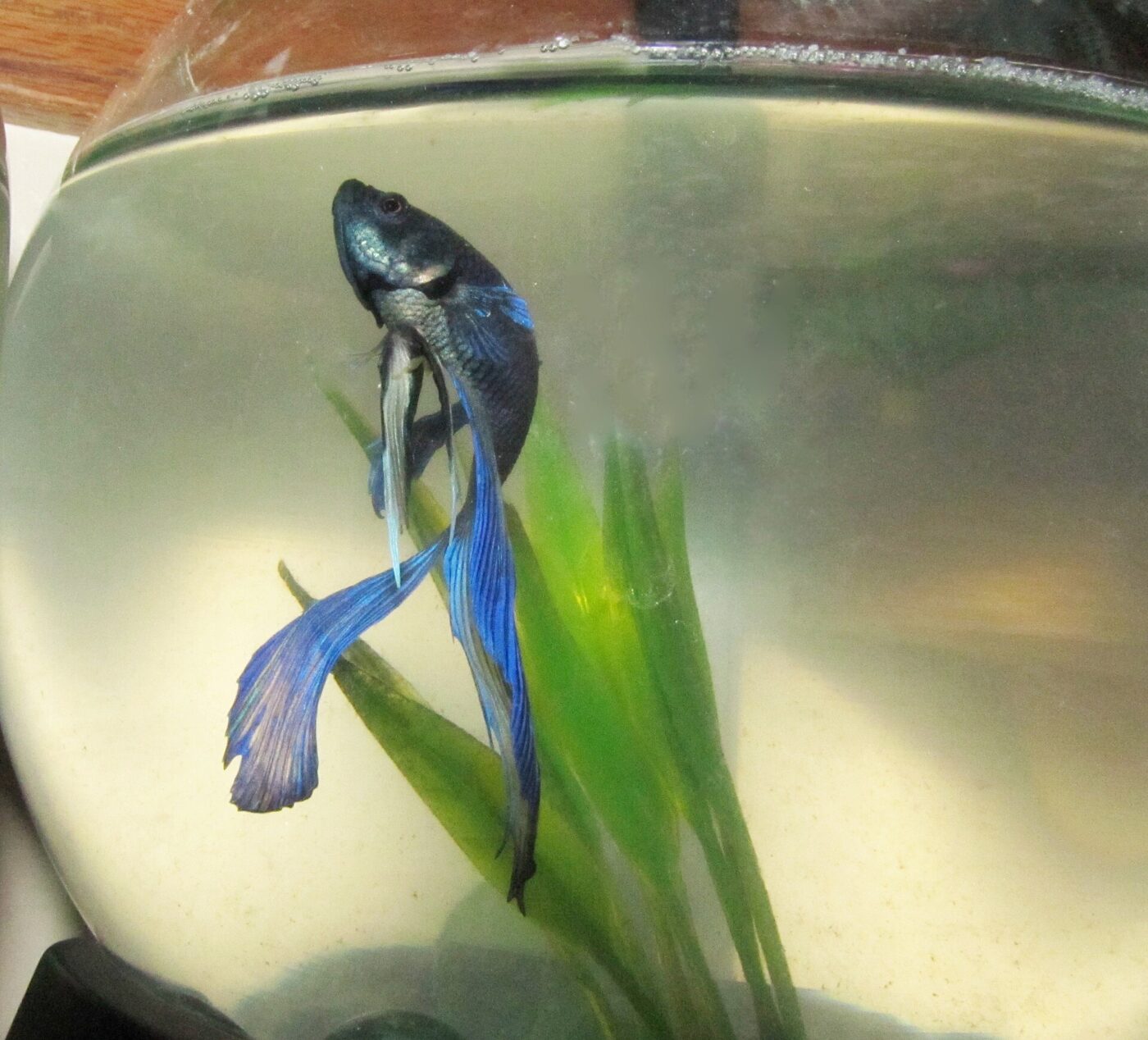
A betta sold in a small cup on a store shelf is not a demonstration of how little space the fish needs. It is a temporary holding container, and the ammonia the fish excretes into that water starts building the moment the cup is sealed.
The same chemistry runs in a bowl at home, just slower. A fish’s gills release ammonia into the surrounding water as a normal part of breathing, and without a filter colonized by the right bacteria, nothing in that water converts it into something less toxic.
Fear Index · Think twice
A bowl that looks calm and is not
UF/IFAS Extension says un-ionized ammonia above 0.05 mg/L can damage a fish’s gill tissue, and concentrations near 2.0 mg/L are lethal to sensitive fish — levels a small, unfiltered bowl can reach fast.
Why a fish cannot get away from its own waste
Fish do not store waste nitrogen the way land animals do. The Merck Veterinary Manual explains that fish excrete ammonia directly from the bloodstream, across the gill epithelium, and into the surrounding water by passive diffusion — a continuous process, not something that only happens when the water looks dirty.
In open water that ammonia disperses. In a bowl with a fixed, small volume of water and no filter, it has nowhere to go. UF/IFAS Extension’s fact sheet on ammonia in aquatic systems puts the danger in concrete terms: un-ionized ammonia above 0.05 mg/L is enough to damage fish tissue, and concentrations near 2.0 mg/L are typically lethal to sensitive species.
None of this is specific to bettas. It is what happens to any fish kept somewhere too small and too static to process what its own body puts into the water.
A bowl is not calmer water. It is the same ammonia problem with less water to dilute it and no filter to remove it.
The nitrogen cycle, from ammonia to nitrate
A filtered, cycled tank solves the ammonia problem with bacteria, not dilution. UF/IFAS Extension describes a two-step bacterial process: one group of bacteria oxidizes ammonia into nitrite, and a second group oxidizes that nitrite into nitrate, which is far less toxic to fish than either compound it came from.
Both bacterial groups need an established colony to keep up with a fish’s ongoing waste output, and that colony does not appear overnight. The Merck Veterinary Manual puts the timeline at up to 8 weeks for a biofilter in a tropical fish tank to become fully established, which is why a filter alone, freshly installed, does not make a tank safe the day the fish goes in.
Nitrite, the middle step, is dangerous in its own right. UF/IFAS Extension’s guidance notes nitrite becomes toxic to fish at concentrations as low as 0.10 mg/L, which is why a mid-cycle tank can still be unsafe even after ammonia itself starts to fall.
Cycling a tank before the fish arrives

The Merck Veterinary Manual recommends cycling the tank before any fish is added. Its fishless-cycling method: set up the tank completely, add ammonia to reach a concentration of at least 1 to 5 mg/L, and test regularly for ammonia, nitrite and nitrate. Once both ammonia and nitrite read zero, the bacteria colony is established and fish can be added.
The alternative, adding fish while the tank cycles around them, carries its own documented risk. The manual warns this approach can result in high ammonia or nitrite concentrations if not done carefully, and describes it as potentially inhumane to the fish exposed to that buildup.
A heater matters here too. Bettas are tropical fish, and Merck’s guidance for pet fish is direct: a heater is necessary for both freshwater and saltwater tropical fish, with tropical species generally kept near 77°F (25°C). A tank that swings with room temperature stresses a fish built for consistently warm water, on top of whatever the ammonia is doing.
Test the water, not the calendar. A tank is cycled when ammonia and nitrite both read zero, not on a fixed number of days.
Sizing by surface area, not a gallon number picked at random
Merck’s guidance for setting up a home aquarium ties stocking to surface area rather than a flat gallon figure: about 1 inch of fish for every 12 square inches of surface area in a freshwater tank. Surface area is what allows oxygen exchange, and along with total water volume it is what determines how much a given bioload gets diluted between water changes.
That is also the honest answer to why a bowl performs worse than a tank holding a similar amount of water: a bowl’s narrow opening limits surface area for gas exchange even when the volume looks comparable, on top of having no filter to house a bacteria colony at all.
A single betta does not need a large footprint to satisfy that math, but it does need enough surface area and volume to support a filter and a stable cycle — which a sealed bowl, by design, cannot.
Reading a test kit instead of guessing
Merck’s guidance for new tanks is to test water quality before adding fish, to confirm conditions are actually optimal rather than assuming a filter running for a few days has already done its job.
Liquid reagent kits read ammonia, nitrite, nitrate and pH as a specific number in mg/L, which is what a cycling tank needs to track meaningfully — not just a color that shifts somewhere within a general range. Test strips are faster and more convenient for a quick check once a tank is established, but they trade away some of that precision.
A weekly test during normal operation, and daily testing during the first weeks after fish go in, catches a stalled or crashed cycle before it becomes a health emergency instead of a number on a chart.
The shortlist
Paid links: we earn a commission if you buy through the buttons below, at no extra cost to you. As an Amazon Associate I earn from qualifying purchases.
Compared on completing a cycle before the fish arrives
| Product type | Best for | Risk estimate | Where to buy |
|---|---|---|---|
| 5-Gallon Aquarium Kit With Filter | A tank roomy enough to dilute waste | 20/100 | See listings on AmazonOpens Amazon search results, not one listing: check the model on the product page. |
| Adjustable Aquarium Heater (25–50W) | Heat that does not swing with the room | 15/100 | See listings on AmazonOpens Amazon search results, not one listing: check the model on the product page. |
| Freshwater Liquid Test Kit (Ammonia, Nitrite, Nitrate, pH) | Testing the water instead of guessing | 12/100 | See listings on AmazonOpens Amazon search results, not one listing: check the model on the product page. |
Risk estimate is our editorial Fear Index for the product type (lower is safer), not a customer rating. How it is scored.
5-Gallon Aquarium Kit With Filter
A filtered tank gives ammonia somewhere to go besides the water a betta breathes, and gives nitrifying bacteria a place to live.
- Filter housing supports a bacteria colony
- More surface area than a bowl
- Room for a heater and thermometer
- Still needs a full cycle before fish go in
- Bigger footprint than a bowl
Freshwater Liquid Test Kit (Ammonia, Nitrite, Nitrate, pH)
A cycling tank is safe when ammonia and nitrite both read zero on a test, not on a fixed number of days.
- Measures ammonia, nitrite, nitrate and pH separately
- Same kit tracks cycling and ongoing water changes
- More precise than test strips
- Slower than a strip, needs reagents and tubes
- Reagents expire and need replacing
More: Pets analyses and how the Fear Index is scored.
Sources
- Ammonia in Aquatic Systems (FA16/FA031) — University of Florida IFAS Extension
- Environmental Diseases of Aquatic Animals in Aquatic Systems — Merck Veterinary Manual
- Management of Aquarium Fish — Merck Veterinary Manual
- Providing a Home for Fish — Merck Veterinary Manual
- Special Considerations for Fish — Merck Veterinary Manual
Questions people actually ask
How big a tank does a betta actually need?
Merck’s guidance ties stocking to surface area, about 1 inch of fish per 12 square inches in a freshwater tank, rather than a fixed gallon number. What matters most is enough volume and surface area to support a filter and a completed nitrogen cycle, which a sealed bowl cannot do.
How long does it take to cycle a fish tank?
The Merck Veterinary Manual puts a tropical fish tank’s biofilter establishment at up to 8 weeks; UF/IFAS Extension describes a similar 6-to-8-week timeline for ammonia-to-nitrite-to-nitrate bacteria to catch up with a fish’s waste output.
What ammonia level is actually dangerous?
UF/IFAS Extension says un-ionized ammonia above 0.05 mg/L can damage gill tissue, and concentrations near 2.0 mg/L are typically lethal to sensitive fish. Nitrite becomes toxic starting around 0.10 mg/L.
Does a betta need a heater?
Yes. Bettas are tropical fish, and Merck’s guidance says a heater is necessary for tropical aquarium fish, with a target near 77°F (25°C) rather than whatever temperature the room happens to be.
Liquid test kit or test strips?
A liquid reagent kit reads ammonia, nitrite, nitrate and pH as specific mg/L numbers, which is what a cycling tank needs. Strips are faster for a quick established-tank check but trade away some of that precision.