
LED Strip Lights Tend to Fail at the Adhesive and Power Supply First
LED strips peel, dim at the far end and run hot in tight spaces. How heat, voltage and power supplies set their life, what IP ratings mean and where to cut.

Part of the guide: Tools and DIY Buying Mistakes: What Fails and How to Check Before You Buy
LED strip lights are one of the cheapest ways to change how a room looks: under cabinets, behind a TV, along a shelf or a ceiling cove. They also generate a steady stream of complaints about strips peeling away, colors shifting and sections going dark.
The LEDs themselves are rarely the first thing to go. The adhesive, the heat in the space where the strip is installed, and the power supply behind it decide whether a strip looks good for years or for weeks.
Fear Index · Think twice
Cheap to buy, fiddly to keep working
A strip that sags off the wall within weeks or starts to dim and flicker is the visible letdown; an overloaded or unlisted power adapter is the less visible risk.
Why the tape lets go
The backing on most strips is a pressure-sensitive adhesive. It bonds well to clean, smooth, dry surfaces at room temperature and poorly to anything dusty, greasy, textured, freshly painted or cold. Kitchen cabinets carry a film of cooking grease, matte wall paint is porous, and the underside of a shelf is often raw particleboard; all are hard surfaces for tape.
Heat and tension finish the job. The strip warms up while lit, which softens the adhesive, and strips bent around corners pull constantly against the bond. On ceilings and the undersides of cabinets gravity joins in, so peeling usually starts at a corner or an end and spreads.
Preparation helps: clean with isopropyl alcohol, let it dry, apply at room temperature and press firmly along the whole length. For anything overhead or around corners, plan for mechanical support rather than tape alone.
Aluminum channels solve two problems at once. They give the strip a surface to stick to and screw the whole assembly in place, and the metal draws heat away from the LEDs.
Heat decides how long they last

ENERGY STAR explains that LEDs use heat sinks to absorb the heat they produce and dissipate it, that LED lifetime is defined by when light output falls by 30 percent, and that the higher the temperature LEDs operate at, the more quickly the light degrades and the shorter the useful life. A bulb has a designed heat sink; a flexible strip is a thin circuit board with little to spread heat.
Enclosed coves, tight channels without airflow and high-density strips running at full brightness all run warmer. Running strips below maximum brightness reduces heat, and mounting them on metal rather than wood or drywall helps. Voltage matters over distance: long runs lose voltage along their thin copper traces, so the far end looks dimmer or a different color. Higher-voltage strips, such as 24 V rather than 12 V, and feeding power into both ends of long runs reduce the effect.
| Spec | What it tells you | Buying rule |
|---|---|---|
| Voltage (12 V or 24 V) | How far a run can go before dimming | Prefer 24 V for longer runs |
| Watts per foot or meter | Heat and power supply size | Multiply by total length |
| LED density | Evenness of light and heat | Higher density needs a channel |
| Cut interval | Where the strip can be shortened | Check it fits your lengths |
| IP rating | Dust and water protection tested | Match to the location |
Power supplies and remotes
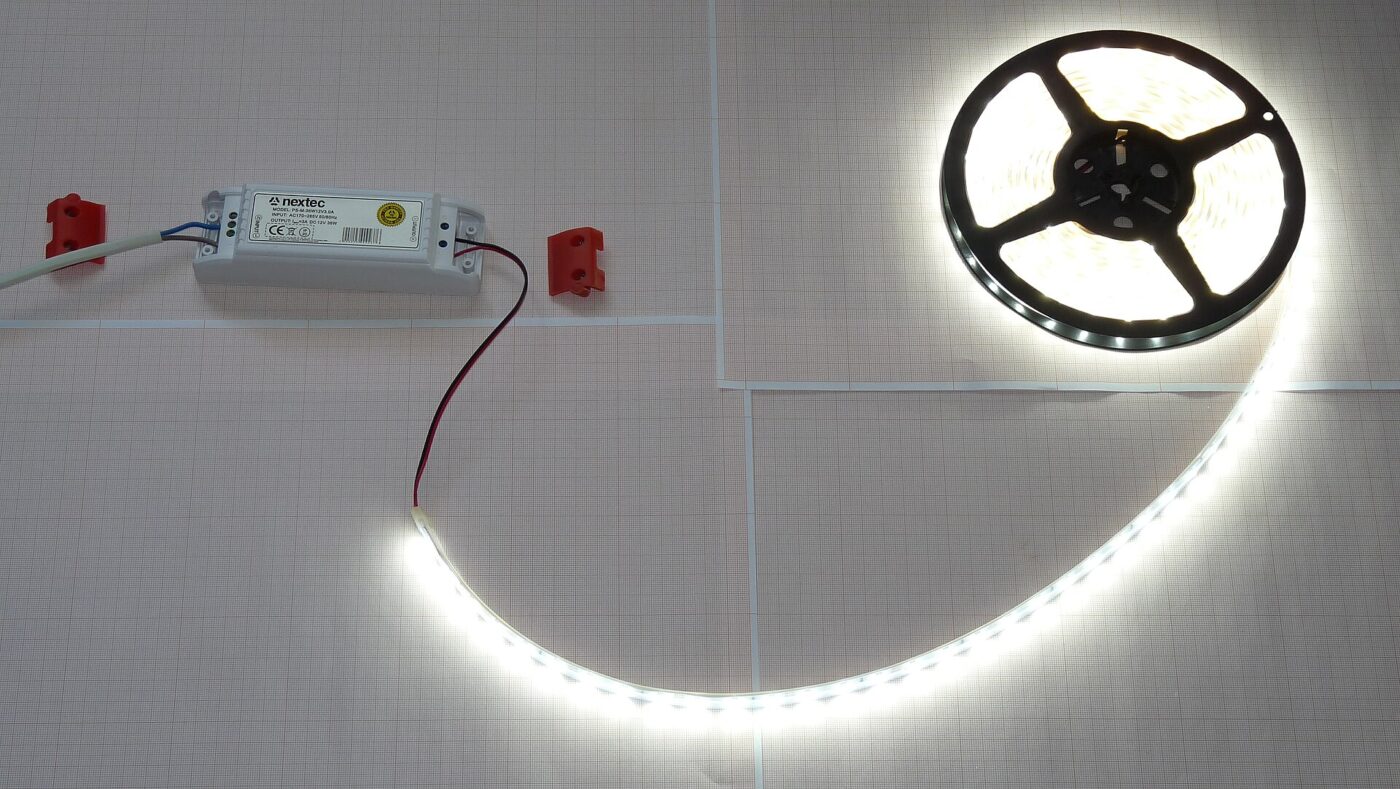
Work out total load by multiplying the strip’s watts per foot by the length you will run, then choose a power supply rated comfortably above that figure rather than exactly at it. An adapter run at its limit gets hot, and heat shortens its life just as it does for the LEDs. Check that the adapter carries a safety certification mark from a recognized testing laboratory, and keep it somewhere ventilated, not buried under insulation or stuffed behind a sofa.
Battery-powered strips and kits with small coin-cell remotes deserve a second look if children are around. In April 2025 CPSC announced a recall of battery-powered LED strip lights sold on AliExpress because they allowed children easy access to lithium coin batteries and lacked required warnings, in violation of the federal rules for products containing button and coin batteries. Swallowed coin batteries can cause serious internal injuries, so check that any coin-cell compartment, in the strip’s battery pack or a remote, is secured with a screw or a firm latch.
- Match the voltage of the supply to the strip; a 12 V strip on a 24 V supply will fail quickly.
- Stay within the maximum run length the maker states before adding a separate power feed.
- Keep connectors dry and strain-free, since clip-on connectors loosen when cables are tugged.
- Do not cover the adapter or coil excess cable tightly around it.
- Store spare coin batteries out of reach and check the remote battery door.
IP ratings and cutting points
IP ratings come from IEC 60529. The first digit rates protection against solids, up to 6 for dust-tight, and the second rates protection against water, from dripping water at the low end to immersion and high-pressure jets at the top. Element, a testing laboratory, gives the example that a product rated IP67 is dust-tight and can be submerged to 1 meter for up to half an hour. Bare strips for dry indoor use are typically low-rated; silicone-coated or sleeved strips are rated higher for damp areas.
A rating applies to what was tested, usually the strip itself. The adapter, controller and connectors are often indoor-only, and cutting a coated strip breaks its seal unless the end is resealed with the maker’s end caps. Coatings also trap heat, so a waterproof strip in a dry cabinet runs warmer for no benefit.
Strips can only be cut at the marked points, usually a line across copper pads every few LEDs. Cutting anywhere else disables the segment. Addressable strips that show moving color effects also have a direction arrow, and the controller must connect to the input end.
The shortlist
Paid links: we earn a commission if you buy through the buttons below, at no extra cost to you. As an Amazon Associate I earn from qualifying purchases.
Compared on what they fix
| Product type | Best for | Risk estimate | Where to buy |
|---|---|---|---|
| 24V LED Strip Kit with Power Supply | A complete, sized setup | 32/100 | See listings on Amazon |
| Aluminum LED Channel with Diffuser | Heat and adhesion | 12/100 | See listings on Amazon |
| LED Strip Mounting Clips | Ceilings and overhangs | 15/100 | See listings on Amazon |
Risk estimate is our editorial Fear Index for the product type (lower is safer), not a customer rating. How it is scored. The buttons open Amazon search results rather than one listing, so check the model on the product page.
Aluminum LED Channel with Diffuser
The most effective fix for both sagging and heat. Measure the strip width before ordering.
- Screws in place so tape cannot peel
- Draws heat away from LEDs
- Diffuser hides individual dots
- Takes longer to install
- Must match strip width
24V LED Strip Kit with Power Supply
A 24 V kit handles longer runs more evenly. Check the adapter for a safety certification mark and the remote for a secure battery door.
- Less dimming along the run
- Supply matched to the strip
- Dimming reduces heat
- Adapter quality varies widely
- Remote may use coin batteries