
A 1,500-Watt Heater Makes the Same Heat Whatever It Looks Like. Placement Decides the Risk.
Oil-filled, ceramic and infrared heaters draw the same wattage and cost the same to run. What differs is warm-up speed, surface heat and fire risk.

Part of the guide: Home and Kitchen Buying Mistakes: What Fails and How to Check Before You Buy
Shoppers comparing an oil-filled radiator, a ceramic fan heater and an infrared quartz heater are usually looking for the one that heats a room for less. At the same 1,500-watt setting, none of them wins that contest: each converts essentially all of its electricity into heat, so the output and the electric bill are the same no matter which box it comes in.
What separates them is how the heat gets out, how hot the unit itself runs, and how it behaves when it tips over or sits too close to a curtain. Those differences, not the wattage, decide which type suits a home office, a bathroom or a drafty garage — and how far it needs to sit from anything that can burn.
Fear Index · Think twice
Same wattage, different ways to start a fire
Every plug-in heater draws about the same power for the same heat, so placement is what turns any of the three types into a house fire. USFA says portable heaters caused only 3 percent of home heating fires but 41 percent of the fatal ones.
The same 1,500 watts, three ways to deliver it
A plug-in electric heater turns the electricity it draws into heat in the room, and EIA’s conversion factor puts one kilowatt-hour at 3,412 British thermal units, so a 1,500-watt heater on high puts out roughly 5,100 Btu an hour whether the element sits in a tank of oil, behind a ceramic plate, or inside a quartz tube. Nothing about the shape changes that arithmetic, and nothing about the shape changes the electric bill for running it.
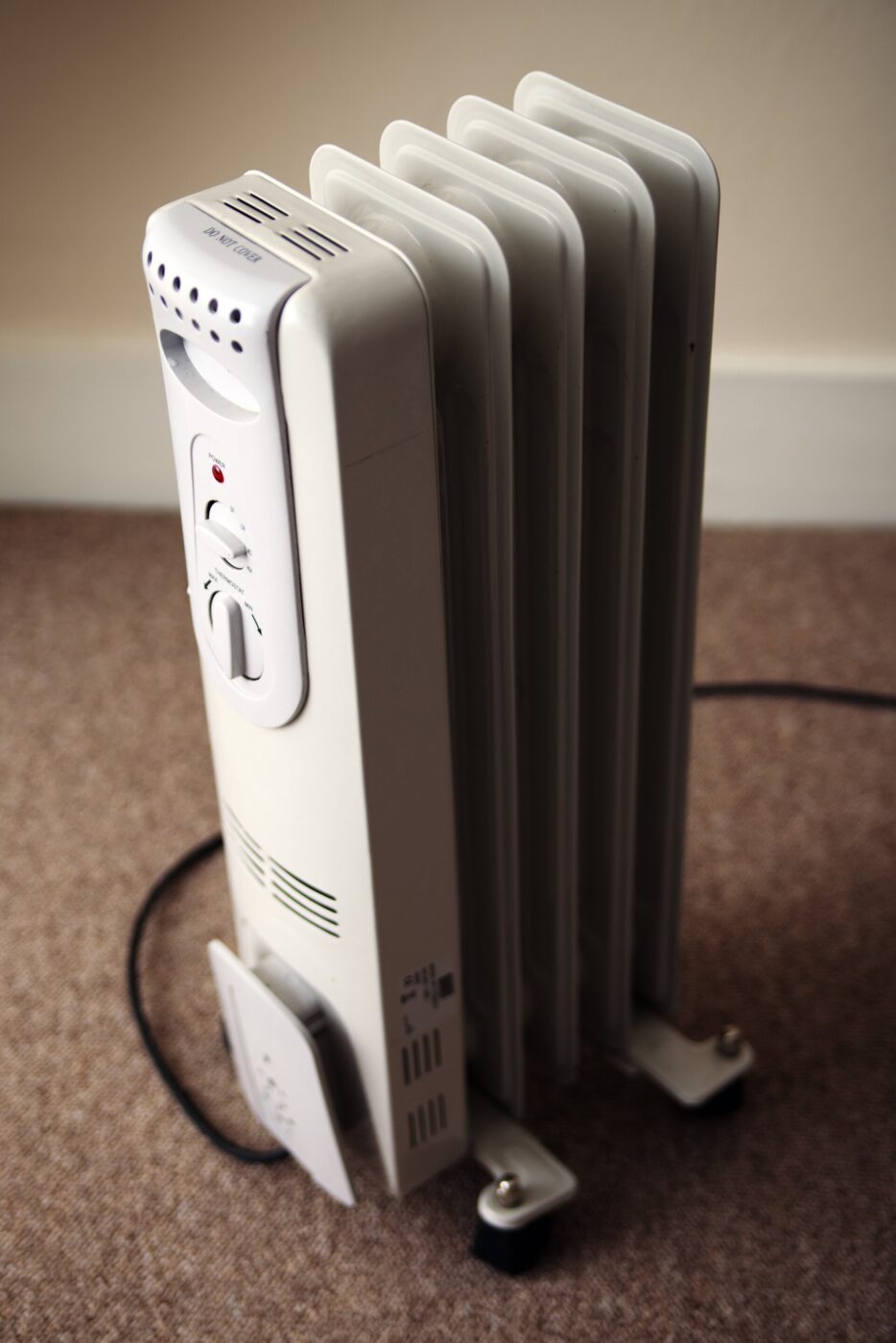
An oil-filled radiator heats a sealed reservoir of oil, which keeps radiating warmth through its fins after the element cycles off. A ceramic heater heats a ceramic plate and typically uses a fan to push that heat into the room quickly, trading the radiator’s slow, steady output for a faster rise near the vents. An infrared quartz heater warms a glowing element that radiates heat directly at people and objects in its path, warming a person before it warms the air across the room.
Buy on warm-up speed and where the heat needs to land, not on a claim that one design is cheaper to run than another at the same wattage.
Where portable heater fires start
The U.S. Fire Administration counted an estimated 32,200 home heating fires in 2021, causing 190 deaths, 625 injuries and $442 million in property damage, and calls heating equipment the second leading cause of home fires. Portable heaters are a small slice of that equipment by fire count but a large slice of the deaths: USFA says home portable heater fires made up only 3 percent of home heating fires annually from 2017 to 2019, yet accounted for 41 percent of the fatal ones.
That gap comes down to where the fire starts. A space heater does not need a spark or a fault to ignite something; it only needs fabric, paper or bedding close enough to its element or warm housing for long enough. CPSC’s January 2026 winter safety release repeats the standing advice: keep portable heaters at least three feet away from drapes, furniture, bedding and other combustible materials, whatever the heater’s design, and turn heaters off when sleeping. CPSC’s heater safety sheet adds: never leave a heater operating while unattended or while you are sleeping.
CPSC put the annual toll at an average of 1,600 fires, 70 deaths and 150 injuries for 2020 to 2022. The exact counts move year to year; the three-foot rule does not.
None of the three heater types is exempt from the three-foot rule. An oil-filled radiator’s lack of a glowing element does not make it safe to push against a couch.
Tip-over switches, overheat cutoffs and lab listings
The clearance rule assumes the heater stays where it was placed and keeps working the way it was designed to. CPSC also tells shoppers to plug electric space heaters directly into a wall outlet, never into an extension cord or power strip, and its heater safety sheet adds a check during use: if the plug, outlet or faceplate is hot, stop using the heater and have a qualified electrician check the outlet.
Beyond clearance and the outlet, CPSC’s safety checklist calls for a heater with thermostat control and an automatic device that turns it off if it tips over frontwards or backwards, and CPSC’s heater sheet says to buy a heater with a safety certification mark from a recognized testing laboratory and to set it on a stable, level surface. Some models also list an overheat cutoff. Those features apply the same way to an oil-filled radiator, a ceramic heater or an infrared unit; none of the three designs makes a tip-over switch unnecessary.
| Feature | Why it matters | Applies to |
|---|---|---|
| Tip-over switch | Cuts power if the heater is knocked over | Every type |
| Thermostat | Cycles the element instead of running on high | Every type |
| Safety certification mark | Shows a recognized lab certified the design | Look for it on the heater |
| Three feet of clearance | Keeps fabric and furniture out of ignition range | A placement habit, not a feature |
Running cost per hour and per season

At the national average residential electricity price of 18.34 cents per kilowatt-hour reported by the U.S. Energy Information Administration for June 2026, a 1,500-watt heater running on high draws 1.5 kilowatt-hours and costs about 28 cents an hour. That figure is the same for the radiator, the ceramic heater and the infrared unit, because it depends only on the wattage and the electric rate, not on the heater’s design.
Run time is what actually separates a light bill from a heavy one. Eight hours a day for a month, at that rate, comes to roughly $66; run the same heater around the clock for a month and it is closer to $198. A thermostat that cycles the element off once the room reaches temperature, rather than running continuously on high, is what actually lowers the bill, and all three heater types can be bought with one.
Electricity rates vary by state and utility, so the EIA average is a starting point for comparison rather than a bill estimate for any specific address.
Which type suits which room
An oil-filled radiator’s slow rise and slow fall in temperature suit a home office or living room where someone is present for hours, and it runs with less of a visibly glowing element than an infrared heater, which matters where pets or small children share the room. A ceramic fan heater’s fast warm-up suits a room used for short stretches, like a bathroom or a garage workspace, where waiting for a radiator to take the chill off is not practical.
An infrared quartz heater’s direct radiant heat suits a drafty space or a spot where one person needs to feel warm quickly, such as a workbench or a porch. Its glowing element sits exposed behind a guard, a reason to be strict about the three-foot clearance from curtains and stored materials, not relaxed about it.
- Home office or living room: oil-filled radiator, for steady heat while someone is in the room.
- Bathroom or garage: ceramic fan heater, for a fast rise in temperature.
- Workbench or porch: infrared quartz heater, for warming a person rather than a room.
- Any of the three: a thermostat and a tip-over shutoff, and off when you leave the room or go to sleep.
The shortlist
Paid links: we earn a commission if you buy through the buttons below, at no extra cost to you. As an Amazon Associate I earn from qualifying purchases.
Compared on placement and running cost
| Product type | Best for | Risk estimate | Where to buy |
|---|---|---|---|
| Oil-Filled Radiator Heater (1,500W) | Steady heat in an occupied room | 30/100 | See listings on Amazon |
| Ceramic Space Heater With Tip-Over and Overheat Shutoff | Fast warm-up in a small room | 28/100 | See listings on Amazon |
| Infrared Quartz Heater With Tip-Over Switch | Directional heat for one spot | 32/100 | See listings on Amazon |
Risk estimate is our editorial Fear Index for the product type (lower is safer), not a customer rating. How it is scored. The buttons open Amazon search results rather than one listing, so check the model on the product page.
Oil-Filled Radiator Heater (1,500W)
Pick the radiator for a room you are in for hours, like a home office. It still needs three feet of clearance, a wall outlet, and switching off when you leave or go to sleep.
- No fan; heat radiates from an oil-filled body
- No exposed glowing element
- Keeps giving off heat once it cycles off
- Slow to warm a cold room
- Heavier and bulkier
Infrared Quartz Heater With Tip-Over Switch
Choose infrared for a workbench or drafty corner, with the same three feet of clearance and a wall outlet as any heater.
- Radiant heat aimed at people and objects
- Warms what is in its path before the air
- Same 1,500 watts as the others
- Exposed glowing element behind a guard
- Heats occupants more than the room