
Dyson vs. Shark Cordless Vacuums: Runtime Footnotes, Battery Cost and Warranty Fine Print
Dyson and Shark publish different warranty lengths, battery terms and runtime footnotes for cordless vacuums. What the fine print says before you buy.

Part of the guide: Home and Kitchen Buying Mistakes: What Fails and How to Check Before You Buy
A cordless vacuum’s spec sheet leads with one runtime number, and the footnote under it says what that number assumes. Dyson’s own footnote says actual run time varies with power mode, dust level, floor type and attachments, and real cleaning on carpet with the motorized floor head running is not the lightest setting.
Dyson and Shark also treat the battery differently once the runtime ends and the warranty period matters more than the spec sheet. The vacuum’s headline number and the battery’s real lifespan are two separate questions, and only one of them is answered on the front of the box.
Fear Index · Think twice
The runtime on the box is not the runtime on carpet
Runtime claims carry footnotes. Dyson says actual run time varies with mode, floor and attachments, and SharkNinja’s manual times its headline figure in ECO mode with the hand vacuum detached from the wand and floor nozzle.
Runtime claims versus real cleaning modes
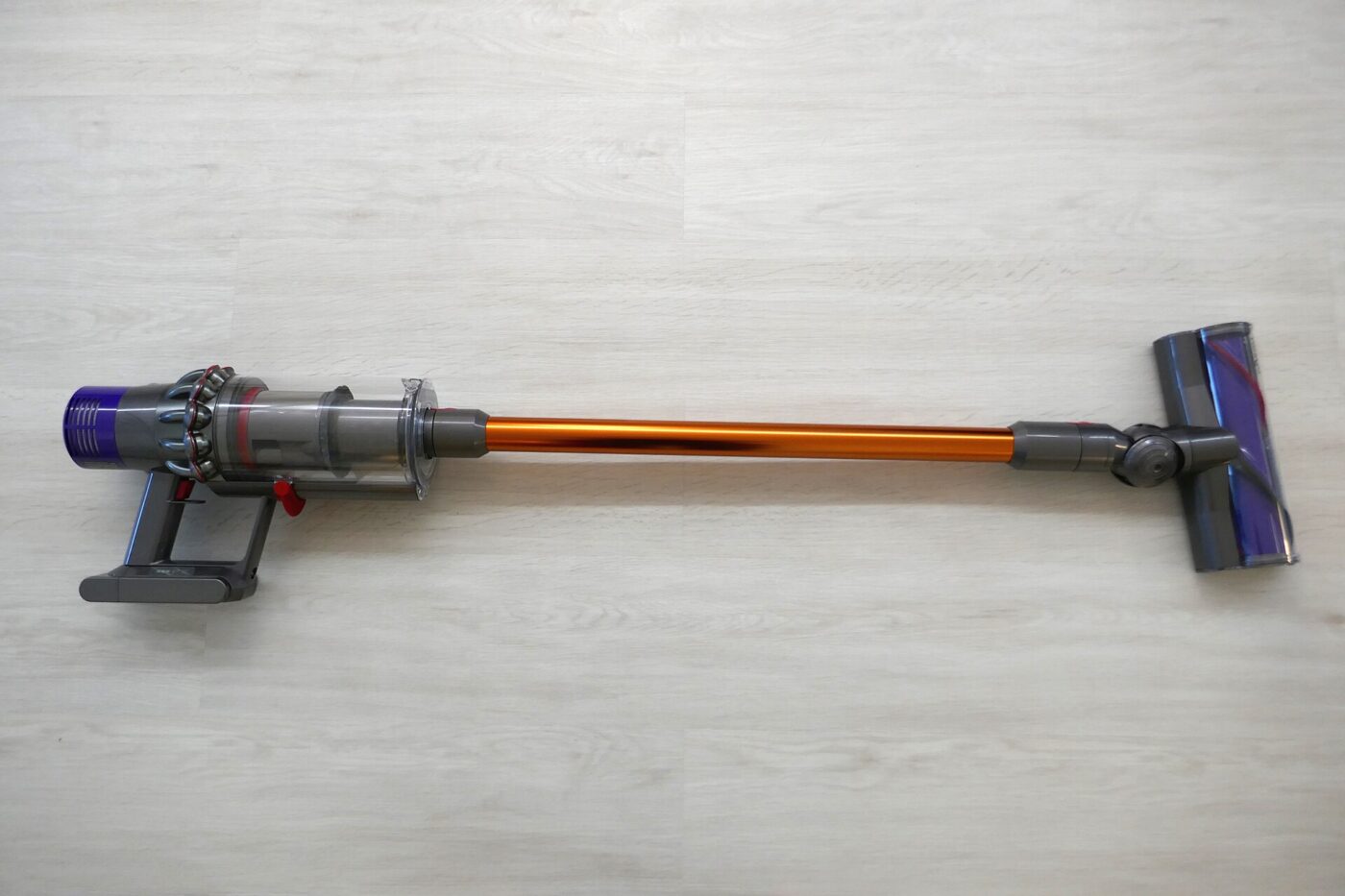
Dyson’s own product page for the V15 Detect lists “up to 60 minutes” of run time, with a footnote that actual run time will vary with power mode, dust level, floor type and attachments. The same page describes Eco mode as the setting for longer run times and Boost as the one for short, intensive cleaning, and its filtration claim, 99.99 percent of particles down to 0.3 microns, is footnoted as a Boost-mode figure, with the other modes rated at least 99.97 percent.
Shark’s printed figure is more specific, and more revealing once you read the footnote. The owner’s guide for its PowerDetect cordless line states the unit gets “up to a 70-minute runtime,” then adds: “In ECO mode with the hand vacuum detached.” The guide lists three modes, ECO, DETECT and BOOST, and detaching the hand vacuum removes the motorized floor nozzle from the circuit entirely. The 70-minute number describes the battery running the machine with no cleaning head attached and no carpet load on a brushroll.
The same manual then tells owners to switch to BOOST mode “for best cleaning on ASTM and IEC cleaning tests.” The setting Shark recommends for actually removing dirt is not the setting that produced its headline runtime.
A vacuum’s printed runtime comes with conditions, sometimes a low-power mode with the cleaning head removed. Expect less than that number on carpet with the motor head running.
Battery lifespan, replacement cost and what the warranty actually covers

Dyson gives its cordless machines a 2-year limited warranty. Its own warranty terms page lists “reduction in battery discharge time due to battery age or use” as something the warranty does not cover, separate from a battery that fails outright from a defect. A battery that simply holds less charge after two years of normal use is not, by Dyson’s own terms, a warranty claim.
Dyson’s own store listed the click-in battery for the V11, V15 Detect and Outsize at $99.99 when checked on September 21, 2026, and a spare part like that carries Dyson’s 1-year warranty on parts, not the machine’s 2 years. Dyson also notes that the V11 comes with two battery types, click-in and screw-in, so the exact model matters. That is the recurring cost of keeping an aging cordless vacuum running past its warranty.
Shark structures the same problem differently. Its owner’s guide gives the unit a Five (5) Year Limited Warranty for “the original unit and/or non-wearable parts,” but the battery is carved out into its own, separate Two (2) Year Limited Battery Warranty, which replaces “the original battery deemed defective” for up to two years and explicitly excludes “normal wear and tear of the battery.” The five-year number on the box does not apply to the battery, and the same guide notes that Shark’s battery, like all lithium-ion batteries, will naturally lose capacity over time.
Read past the headline warranty length. Dyson insures the battery against defects for 2 years and excludes ordinary capacity loss; Shark separates its battery warranty out at 2 years even though the unit carries 5.
What the warranties actually promise, compared
The FTC’s guide to federal warranty law explains that a warranty labeled “limited” does not meet the federal minimum standards for a “full” warranty, and that a written warranty has to spell out in simple, readily understood language what is covered, for how long, what is excluded and how to get service. Both Dyson and Shark use limited warranties, and both draw a line around the battery specifically.
Neither company’s warranty is a substitute for checking recalls before buying secondhand or from an unfamiliar seller; CPSC keeps an updated database at cpsc.gov/Recalls for exactly that check.
| Coverage | Dyson | Shark |
|---|---|---|
| Unit warranty | 2 years | 5 years, non-wearable parts |
| Battery warranty | 2 years; excludes normal capacity loss | 2 years, separate from the unit warranty |
| Who it covers | Original buyer, from Dyson or an authorized seller, with proof of purchase | Original owner, from an authorized retailer, with receipt |
| Registration | Optional My Dyson account | Requested when filing a claim |
Filtration, bins and hair tangling
The Dyson V15 Detect carries a 0.77-liter bin, per Dyson’s own spec page, a figure worth weighing against the size of the home. Shark’s PowerDetect owner’s guide describes a hand-vacuum dust cup emptied by pulling a lever on its base, with a HEPA filter and a separate pre-motor filter; the guide says to rinse the HEPA filter at least once a month with water only and let it air-dry for up to 48 hours before reinstalling.
Both brands market hair-shedding heads on some models: Dyson describes the V15’s Digital Motorbar head as de-tangling, and Shark sells some cordless lines with self-cleaning brushrolls, so check the listing for the exact vacuum rather than assuming every stick includes one. Shark’s own troubleshooting instructions still tell owners to “remove any string, carpet fibers, or hair that may be wrapped around the brushroll” when suction drops, which is a maintenance step on any brush-roll vacuum, self-cleaning branding or not. For the same problem on robot vacuums, see our guide to robot vacuums and hair.
Weight, stairs and which vacuum fits which home
Both brands build their cordless lines around a detachable hand vacuum on a wand, so weight on stairs is mostly a question of the specific model rather than the brand: heavier battery packs and larger bins add weight at the top of the wand, which matters more when the vacuum is held overhead on a staircase than when it is pushed across a floor. Dyson lists the V15 Detect at 6.83 lb; check the specific Shark model’s listing for its figure.
A household comparing the two is really weighing the 5-year unit warranty in Shark’s PowerDetect guide against Dyson’s 2 years, since the battery on either brand is covered for 2 years against defects and neither covers ordinary capacity loss. Price a genuine replacement battery for the specific model before comparing sticker prices, since both makers treat lithium-ion capacity loss from age and use as normal.
Neither brand’s warranty covers ordinary battery aging. Decide between them on unit coverage length and battery replacement cost, not on the number printed largest on the box.
The shortlist
Paid links: we earn a commission if you buy through the buttons below, at no extra cost to you. As an Amazon Associate I earn from qualifying purchases.
Compared on cordless vacuum ownership
| Product type | Best for | Risk estimate | Where to buy |
|---|---|---|---|
| Dyson Cordless Stick Vacuum | Full-size cordless cleaning | 30/100 | See listings on Amazon |
| Shark Cordless Stick Vacuum | Longer unit warranty, some models | 28/100 | See listings on Amazon |
| Genuine Dyson Replacement Battery | A genuine battery, not a knockoff | 20/100 | See listings on Amazon |
Risk estimate is our editorial Fear Index for the product type (lower is safer), not a customer rating. How it is scored. The buttons open Amazon search results rather than one listing, so check the model on the product page.
Shark Cordless Stick Vacuum
Shark’s PowerDetect guide gives the unit a longer warranty than Dyson’s, but check the exact model’s own terms, the runtime footnote and the separate battery warranty before comparing sticker prices.
- Five-year unit warranty on PowerDetect
- HEPA filter rinses with water
- Dust cup empties with a lever
- Battery warranty is only 2 years
- Runtime claim uses ECO, head detached
Genuine Dyson Replacement Battery
CPSC has warned about a third-party lithium-ion pack for Dyson V6 models, sold on Amazon and not made or authorized by Dyson, after three fire reports; a genuine part avoids that exact problem.
- Made by Dyson for the listed models
- Carries Dyson’s 1-year parts warranty
- Not the third-party pack CPSC flagged
- V11 uses two battery types; match yours
- Restores run time, not other faults