
A Thermometer That Reads 165°F in the Wrong Spot Still Serves an Undercooked Turkey
USDA’s safe temperatures only protect you if the probe reaches the coldest part of the food. Thermocouple, thermistor and dial types compared.

Part of the guide: Home and Kitchen Buying Mistakes: What Fails and How to Check Before You Buy
USDA’s cooking temperatures are specific: 165°F for poultry, 160°F for ground meat, 145°F with a 3-minute rest for whole cuts of beef, pork, lamb and veal. None of that protects anyone if the thermometer’s tip lands in the wrong part of the food.
Thermometers differ in how fast they respond, how thick their probe is, and whether they can be trusted without a check first. The type that suits a Thanksgiving turkey is not automatically the type that works on a thin pork chop or a pot of candy.
Fear Index · Think twice
A correct-looking number from the wrong spot
USDA says most food thermometers read within 2 to 4°F of the true temperature even when they are working correctly, and placement error is an entirely separate problem from accuracy.
USDA temperatures and the coldest spot
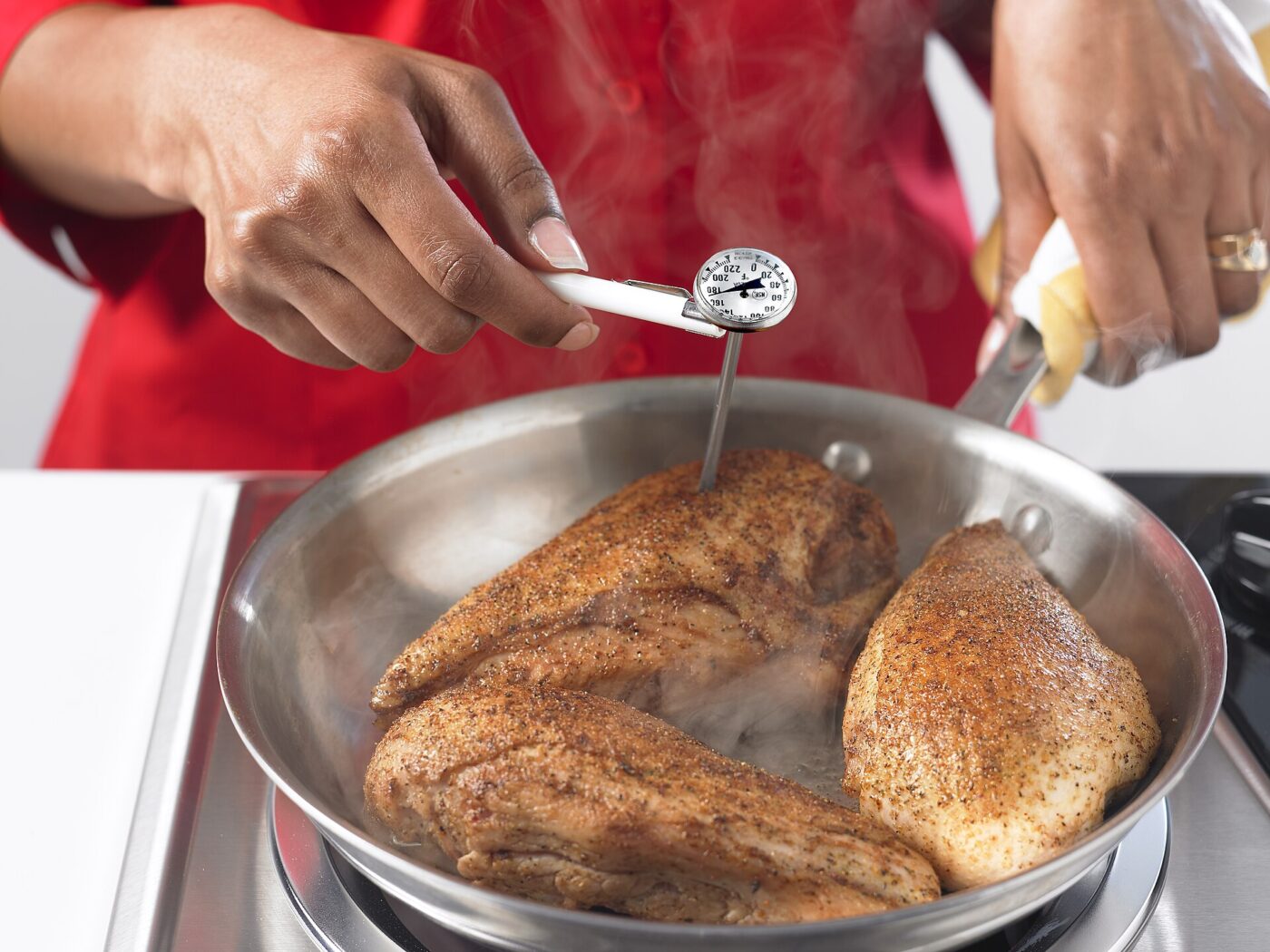
USDA’s Kitchen Thermometers fact sheet lists its recommended internal temperatures: ground beef, pork, veal and lamb at 160°F; ground turkey and chicken at 165°F; whole poultry, poultry breast and stuffing at 165°F; fresh beef, pork, veal and lamb steaks, roasts and chops at 145°F, measured before removing the meat from heat, with at least a 3-minute rest; fresh ham at 145°F with the same rest; pre-cooked ham reheated to 140°F; egg dishes at 160°F; and leftovers or casseroles at 165°F.
None of those numbers means anything if the thermometer is not actually in the food’s coldest spot. USDA’s guidance is to place the thermometer “in the thickest part of the food, away from bone, fat, or gristle,” and to check an irregularly shaped cut, such as a roast, in several places rather than once.
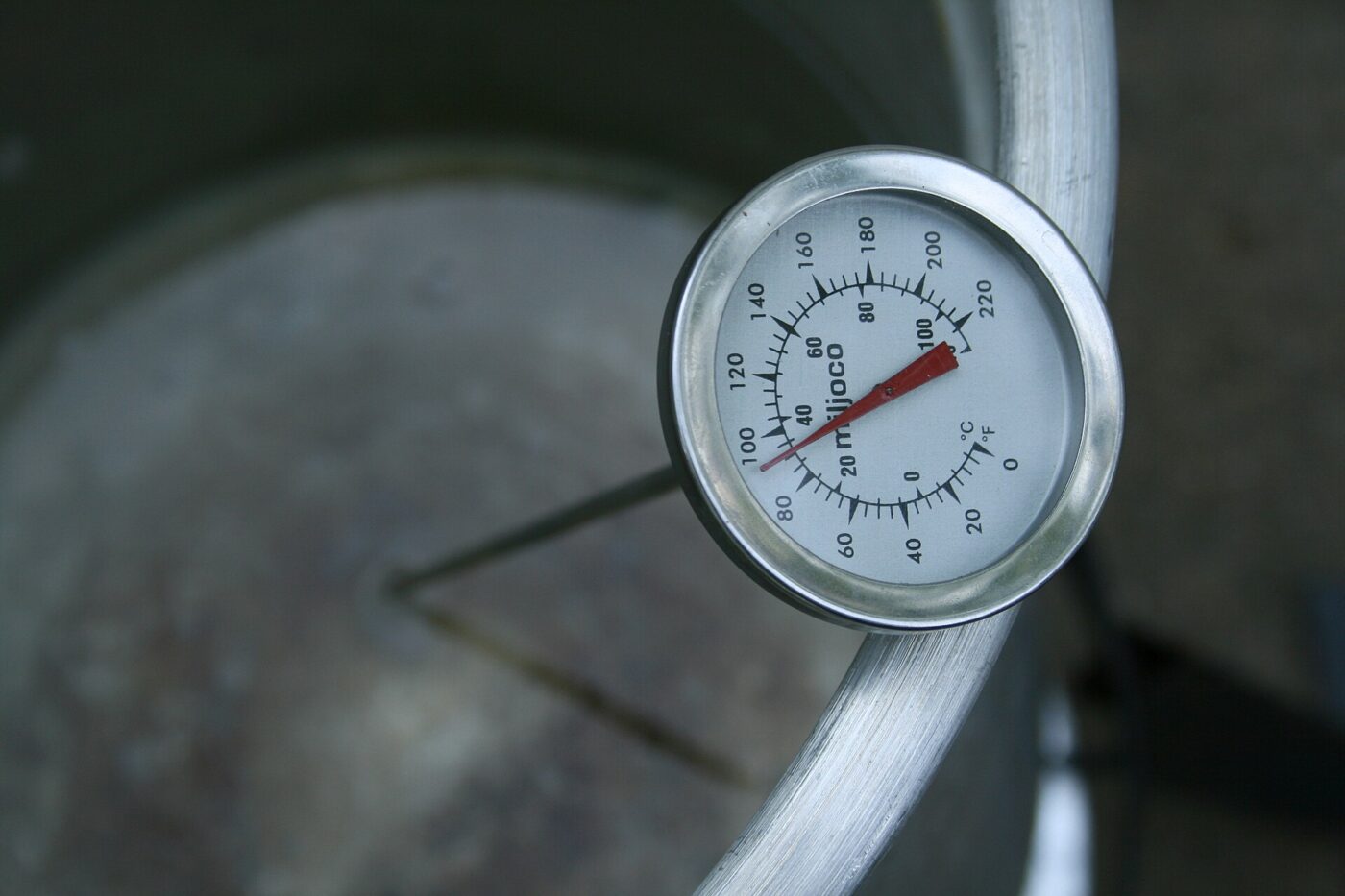
Dial bimetal-coil thermometers add a specific placement trap USDA calls the “potato nail effect”: because heat conducts along the stem’s metal surface faster than through the food itself, the spot touching the thermometer reads hotter than food a short distance away. USDA’s fix is to check a second, and even third, location before trusting the number.
A correct-looking number from the wrong spot is not a safe temperature. Check the thickest part, away from bone, and more than once on an irregular cut.
Thermocouple, thermistor and dial: how they differ
USDA’s own fact sheet lays out the tradeoffs. Thermocouples reach a final reading in 2 to 5 seconds, sense temperature at the junction of two fine wires in a probe tip that can be as thin as 1/16 inch, need to go in only 1/4 inch or as needed, work on thick and thin foods alike, and can be calibrated — but they cost more and can be harder to find in stores.
Thermistors use a ceramic semiconductor in the tip, take about 10 seconds to register, need a probe inserted at least 1/2 inch deep, and are widely available in kitchen stores, though USDA notes “not all thermistors can be calibrated” and the manufacturer’s instructions should be checked.
Dial bimetal-coil thermometers come in two styles. The oven-safe version can stay in the food while it cooks but takes 1 to 2 minutes to register if it was not already inserted, and its 2 to 2.5-inch sensing coil means it is “not appropriate” for food less than 3 inches thick. The instant-read version reads in 15 to 20 seconds but needs that same 2 to 2.5-inch insertion depth, so thin foods have to be pierced sideways to get an accurate reading.
| Type | Speed | Insertion depth |
|---|---|---|
| Thermocouple | 2 to 5 seconds | 1/4 inch or as needed |
| Thermistor | About 10 seconds | At least 1/2 inch |
| Dial, oven-safe | 1 to 2 minutes if not left in | 2 to 2.5 inches |
| Dial, instant-read | 15 to 20 seconds | 2 to 2.5 inches |
A thin thermocouple or thermistor probe suits thin foods; a thick dial stem needs at least 3 inches of food to average across.
Checking calibration in ice water

USDA describes two ways to check a thermometer’s accuracy. For the ice water method, fill a large glass with finely crushed ice, add tap water to the top and stir, then immerse the stem at least 2 inches into the mixture without touching the sides or bottom. Wait at least 30 seconds, then, without removing the stem, turn the calibration nut under the head until the pointer reads 32°F. The boiling water method works the same way, immersing the stem at least 2 inches in a full rolling boil for at least 30 seconds and adjusting to 212°F, though USDA notes altitude and atmospheric pressure can shift true boiling point by a few degrees.
Not every thermometer can be adjusted. USDA’s own comparison table lists oven cord thermometers and thermometer-fork combinations as unable to be calibrated at all. For those, USDA’s advice is to note the offset and correct for it: if a thermometer reads 214°F in boiling water, it is 2 degrees too high, so 2 degrees should be subtracted from any reading, or added to any target temperature, such as cooking ground beef to 162°F instead of 160°F on that specific unit.
Check calibration before the holiday, not during it. An inaccurate 165°F reading gives false reassurance about food that may not have reached it.
Turkey placement: thigh, breast and stuffing
USDA’s Let’s Talk Turkey guide puts a whole turkey’s safe minimum at 165°F, checked “in the innermost part of the thigh and wing and the thickest part of the breast,” not just one spot. USDA recommends against stuffing the bird at all; if it is stuffed, the center of the stuffing itself must independently reach 165°F, which a thermometer placed only in the thigh will never confirm.
Pop-up timers, USDA notes, have been common in turkeys and roasting chickens since 1965 and work by an organic firing material that dissolves at a set temperature, releasing a spring-loaded stem. USDA calls them “reliable and accurate to within 1 to 2°F,” but adds that “proper placement is important” and that “checking with a conventional food thermometer is always recommended as an added precaution.”
A pop-up timer alone is not USDA’s recommendation. Use it, then confirm with a thermometer in the thigh, the wing and the breast.
Wireless probes and choosing by task
USDA’s fact sheet predates wireless leave-in probes, but its closest category is the “oven cord” thermometer: a thermistor probe on a long cord to a base unit, designed to stay in the food while it cooks. USDA lists that style as unable to be calibrated. For any thermometer that cannot be adjusted, USDA’s advice is still to check it in ice or boiling water and either correct for the offset or replace it.
A single instant-read thermocouple or thermistor covers most kitchen tasks: steaks, chops and chicken breasts checked near the end of cooking, and a final check in a turkey’s thigh, wing and breast. A leave-in wireless or oven-cord probe adds value mainly for a long roast or a smoker, where opening the door repeatedly to check loses heat. For candy or deep frying, USDA notes dedicated candy/jelly/deep-fry thermometers measure from 100°F to 400°F for those tasks.
The shortlist
Paid links: we earn a commission if you buy through the buttons below, at no extra cost to you. As an Amazon Associate I earn from qualifying purchases.
Compared on speed and calibration
| Product type | Best for | Risk estimate | Where to buy |
|---|---|---|---|
| Instant-Read Thermocouple Thermometer | Fastest check, thick or thin food | 15/100 | See listings on Amazon |
| Wireless Leave-In Meat Probe | Continuous monitoring for a roast | 25/100 | See listings on Amazon |
| Oven-Safe Probe Thermometer with Alarm | Budget leave-in option | 20/100 | See listings on Amazon |
Risk estimate is our editorial Fear Index for the product type (lower is safer), not a customer rating. How it is scored. The buttons open Amazon search results rather than one listing, so check the model on the product page.
Instant-Read Thermocouple Thermometer
USDA notes the thermocouple design gives the fastest reading of any food thermometer, and it works equally well on a thick roast or a thin chicken breast.
- Reads in 2 to 5 seconds
- Accurate on thick and thin foods alike
- Can be calibrated in ice water
- Costs more than a basic dial probe
- Not designed to stay in food while it cooks
Wireless Leave-In Meat Probe
Useful for a long roast, but confirm placement in the thickest part and check a second spot before trusting one probe alone.
- Stays in the food through the whole cook
- Alarm sounds at the set temperature
- Avoids repeatedly opening the oven
- USDA’s oven-cord category cannot be calibrated
- Still needs a final check in the thigh and breast
More: Home and Kitchen analyses and how the Fear Index is scored.
Sources
- Kitchen Thermometers, USDA Food Safety and Inspection Service fact sheet (copy hosted by the Maryland Department of Health) — USDA FSIS
- Let’s Talk Turkey, USDA FSIS consumer guide (copy hosted by University of Wisconsin–Madison Extension) — USDA FSIS
- Using Thermometers in the Kitchen — University of Connecticut Extension
Questions people actually ask
What temperature is a turkey safe to eat?
USDA says a whole turkey is safe at a minimum internal temperature of 165°F, checked in the innermost part of the thigh, the wing, and the thickest part of the breast.
Where do you put a meat thermometer in a turkey?
USDA’s guidance is the thickest part of the inner thigh first, then the wing and the thickest part of the breast. If the bird is stuffed, the center of the stuffing must separately reach 165°F.
How do you calibrate a meat thermometer?
USDA’s ice-water method: submerge the stem at least 2 inches in crushed ice and water for at least 30 seconds, then adjust the nut under the dial until it reads 32°F. A boiling-water check works the same way, adjusted to 212°F.
Is a pop-up turkey timer accurate enough on its own?
USDA calls pop-up timers reliable to within 1 to 2°F when placed correctly, but still recommends checking with a separate food thermometer as an added precaution.
What is the difference between a thermocouple and a thermistor?
Both are digital, but USDA says a thermocouple reads in 2 to 5 seconds and can be calibrated, while a thermistor takes about 10 seconds and not every model can be calibrated.