
An Electric Pressure Cooker Reaches Pressure. That Still Does Not Make It a Pressure Canner.
Reaching pressure is not the same as a tested process. What the National Center for Home Food Preservation says about canning in electric multi-cookers.

Part of the guide: Home and Kitchen Buying Mistakes: What Fails and How to Check Before You Buy
An electric multicooker with a “canning” or “steam canning” button will absolutely reach pressure. The read-out says so, the lid locks, the timer counts down, and the whole sequence feels exactly like using a stovetop pressure canner.
The National Center for Home Food Preservation says that feeling is not the same as a tested process. NCHFP does not support USDA canning processes in electric multi-cooker appliances, because those processes were developed and timed for stovetop pressure canners, not for the sensors and heating elements inside a countertop multicooker.
Fear Index · High risk
A canning button that skips the tested process
NCHFP says it does not support USDA pressure-canning processes in electric multi-cooker appliances with a canning or steam-canning button, because those processes were never developed for that type of appliance.
Why low-acid food needs a validated pressure process
CDC says pressure canning is the only recommended method for canning low-acid foods — fresh vegetables, meat, poultry, fish, seafood and some tomatoes are on that list. Boiling water alone cannot reach a high enough temperature to reliably destroy Clostridium botulinum spores in a low-acid product.
NCHFP’s own guidance explains why: USDA-published home-canning processes for vegetables other than tomatoes have relied on pressure processing since 1943, and boiling-water, oven and open-kettle canning have been described as unsafe for low-acid foods for exactly as long. A UGA Extension heat-penetration study processed jars at 121.1°C — about 250°F — to reach that standard.
Every part of that number depends on the canner holding pressure steady for the full published time. UGA Extension’s pressure-canner fact sheet is direct about what happens when it does not: a loss of pressure at any point means the timing starts over completely, from the beginning, using the full original process time.
The temperature, not the pressure reading alone, is what destroys the spores — and it has to hold for the whole published time, not just touch the target once.
What NCHFP says about electric multi-cookers

NCHFP’s position is stated plainly on its own site: it does not support the use of USDA canning processes in electric multi-cooker appliances now containing a “canning” or “steam canning” button, because its pressure-process directions were not developed for that type of appliance.
Two mechanisms explain the caution. One is heat penetration: no published USDA thermal-process work has tracked actual temperatures inside jars processed in an electric pressure cooker the way it has for stovetop canners. The other is cooling: retained heat during a canner’s natural cool-down is part of what the sterilizing calculation counts on, and NCHFP says that is why it recommends only canners that hold four or more quart-size jars — a smaller vessel cools, and stops contributing that heat, too quickly.
The one electric exception NCHFP names is the Ball Automatic Home Canner, a dedicated electric canner built and tested for acid foods only — not a general-purpose multicooker with a canning button added to a device also built to make yogurt, rice and stew.
A “canning” button is a feature name, not a validated process. NCHFP’s objection is specifically that nobody has measured what that button actually does inside the jar.
Dial gauge vs weighted gauge stovetop canners
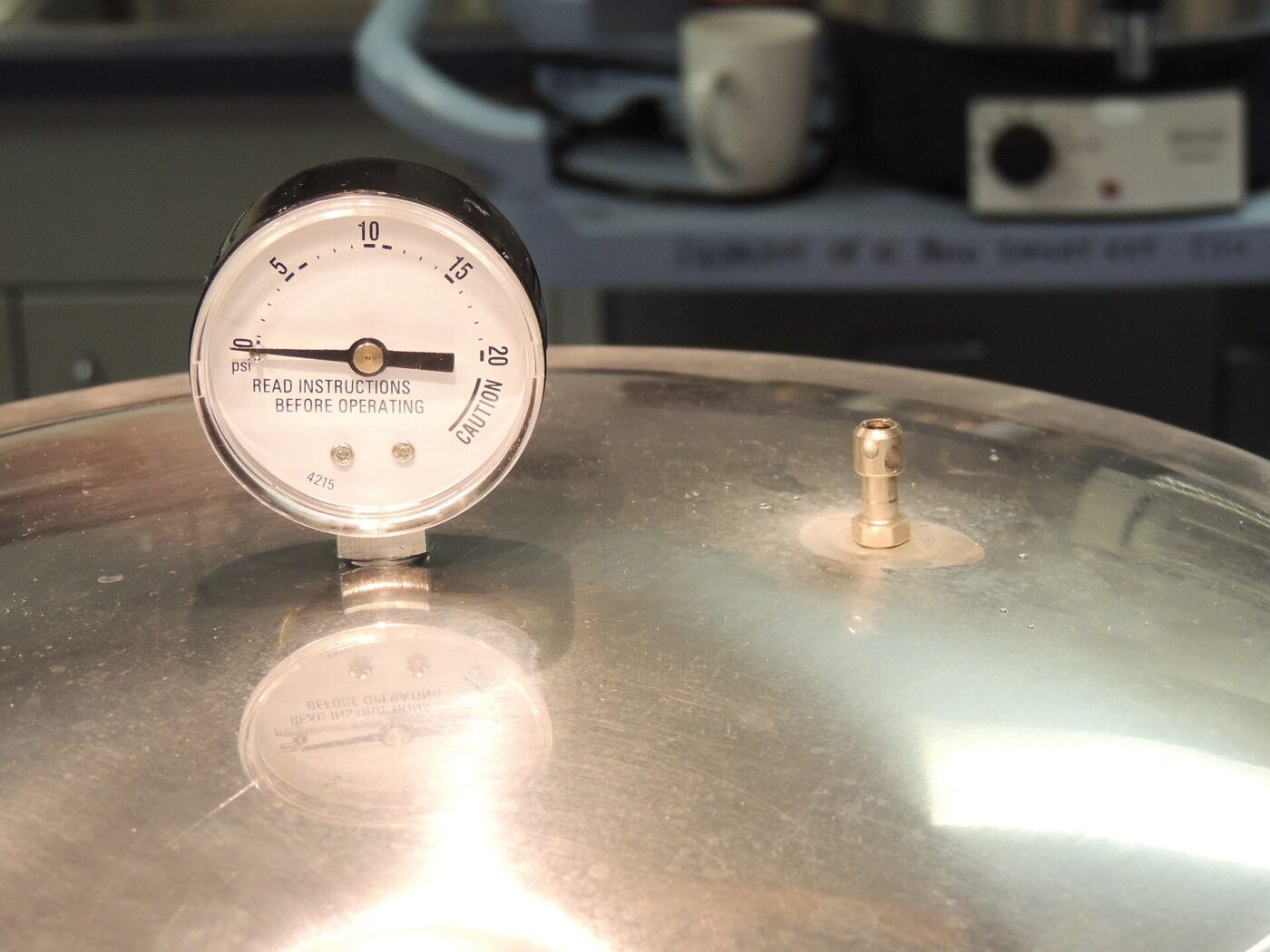
Stovetop pressure canners come with one of two gauge types. A dial gauge displays pressure directly on a numbered face and, per UGA Extension’s pressure-canner guide, needs to be checked for accuracy at least once a year, and any time it has been dropped, submerged, or shows a cracked or missing glass. Reading more than 2 pounds off at 5, 10 or 15 pounds of pressure means replacing it outright; less than 2 pounds off can be adjusted for.
A weighted gauge indicates and regulates pressure by jiggling or rocking, in 5-pound increments up to 15 pounds, and never needs the same annual calibration check — there is no dial to drift out of true. The tradeoff is precision: a dial lets a canner read and hold an exact pressure, while a weighted gauge works in fixed steps.
The stakes for gauge accuracy are not abstract. UGA Extension’s fact sheet says a 1-pound error in a 20-minute process can cut the sterilizing effect by more than 10 percent, and a 2-pound error can cut it by 30 percent — the kind of margin a multicooker’s sealed, unlabeled pressure sensor gives a home canner no way to check at all.
| Gauge type | Needs annual check | How it shows pressure |
|---|---|---|
| Dial gauge | Yes, at least once a year | Numbered dial reading |
| Weighted gauge | No dial to calibrate | Jiggles or rocks at set weights |
Whichever gauge type is chosen, it is a number a canner can see and check. A multicooker’s internal sensor is not.
Altitude, venting and the cool-down step a cooker skips
Pressure has to increase with elevation, because internal canner pressure — and the temperature it produces — is lower at higher altitude for the same gauge reading. UGA Extension’s guidance is direct: check reliable canning instructions for the elevation adjustment rather than assuming sea-level timing applies.
Before pressurizing, USDA recommends venting a stovetop canner for a full 10 minutes so trapped air does not lower the temperature the process reaches at a given pressure. After processing, the canner needs to cool naturally — UGA Extension warns against force-cooling with cold water or opening the vent early, both of which can cause seal failures.
That natural cool-down is exactly the step NCHFP flags as a risk in a small electric vessel: the retained heat while a canner cools is part of what the sterilizing value counts on, and a countertop multicooker with thin walls has less mass to hold that heat through a slow, even cool-down.
Venting, holding pressure and cooling down slowly are three separate steps in the tested process. A multicooker automates the middle one and gives no visibility into the other two.
Tested recipes only: where to find them
A canner is only as safe as the process time it is following. NCHFP publishes USDA-tested processing times by food, jar size and altitude, and maintains the current edition of the USDA Complete Guide to Home Canning those times are drawn from.
A recipe passed along without a specific pressure, jar size and processing time attached — whether from a blog, a family recipe card, or a multicooker’s own recipe booklet — has not shown it was tested against Clostridium botulinum at all. Matching a real USDA or NCHFP process to the food being canned is the step a canning button cannot replace, however it is labeled.
The safest canner in the kitchen is only as safe as the process time punched into it. Get that number from NCHFP or USDA, not from the appliance’s own marketing.
The shortlist
Paid links: we earn a commission if you buy through the buttons below, at no extra cost to you. As an Amazon Associate I earn from qualifying purchases.
Compared on canners built for a tested process
| Product type | Best for | Risk estimate | Where to buy |
|---|---|---|---|
| Stovetop Pressure Canner with Dial Gauge | A canner sized and gauged for tested times | 25/100 | See listings on AmazonOpens Amazon search results, not one listing: check the model on the product page. |
| Weighted-Gauge Pressure Canner | A heavier canner for large-batch canning | 22/100 | See listings on AmazonOpens Amazon search results, not one listing: check the model on the product page. |
| Canning Jar Lifter and Utensil Kit | Handling jars safely once loaded | 10/100 | See listings on AmazonOpens Amazon search results, not one listing: check the model on the product page. |
Risk estimate is our editorial Fear Index for the product type (lower is safer), not a customer rating. How it is scored.
Stovetop Pressure Canner with Dial Gauge
A dial-gauge canner sized for at least four quart jars matches the sizing USDA’s published processes assume, at the cost of a yearly calibration check.
- Holds 4+ quart jars per USDA sizing
- Dial gauge shows the exact pressure
- Works with published USDA process times
- Dial needs a yearly accuracy check
- Small errors cut sterilizing effect
Weighted-Gauge Pressure Canner
A weighted gauge jiggles or rocks to show pressure instead of reading it on a dial, which removes the annual accuracy check entirely.
- No dial gauge to calibrate yearly
- Metal-to-metal seal on some models
- Common weights cover 5, 10 and 15 lb
- Cannot fine-tune pressure like a dial
- Heavier and pricier than dial models
More: Homesteading and Food Craft analyses and how the Fear Index is scored.
Questions people actually ask
Can I pressure can in an Instant Pot or similar multicooker?
NCHFP does not support it. The organization says USDA canning processes have not been developed for electric multi-cooker appliances, even ones with a canning or steam-canning button.
What temperature does pressure canning reach?
A UGA Extension heat-penetration study processed jars at 121.1°C, about 250°F — well above what a boiling-water canner can reach, which is why low-acid foods need pressure canning specifically.
How big does a pressure canner need to be?
USDA recommends a canner large enough to hold at least four quart-size jars; small pressure saucepans are not recommended for home canning.
How often should I check my canner’s dial gauge?
At least once a year, per UGA Extension’s guidance, and any time it has been dropped, submerged, or shows visible damage. Replace it if it reads more than 2 pounds off.
Does altitude change how I pressure can?
Yes. Internal canner pressure and temperature run lower at higher elevation for the same gauge reading, so pressure has to increase with altitude, per reliable canning instructions.