
Stud Finders Do Not Find Studs. They Find Density Changes.
Electronic stud finders detect changes in density behind the surface. Pipes, cables, insulation and joins all look like studs.

Part of the guide: Tools and DIY Buying Mistakes: What Fails and How to Check Before You Buy
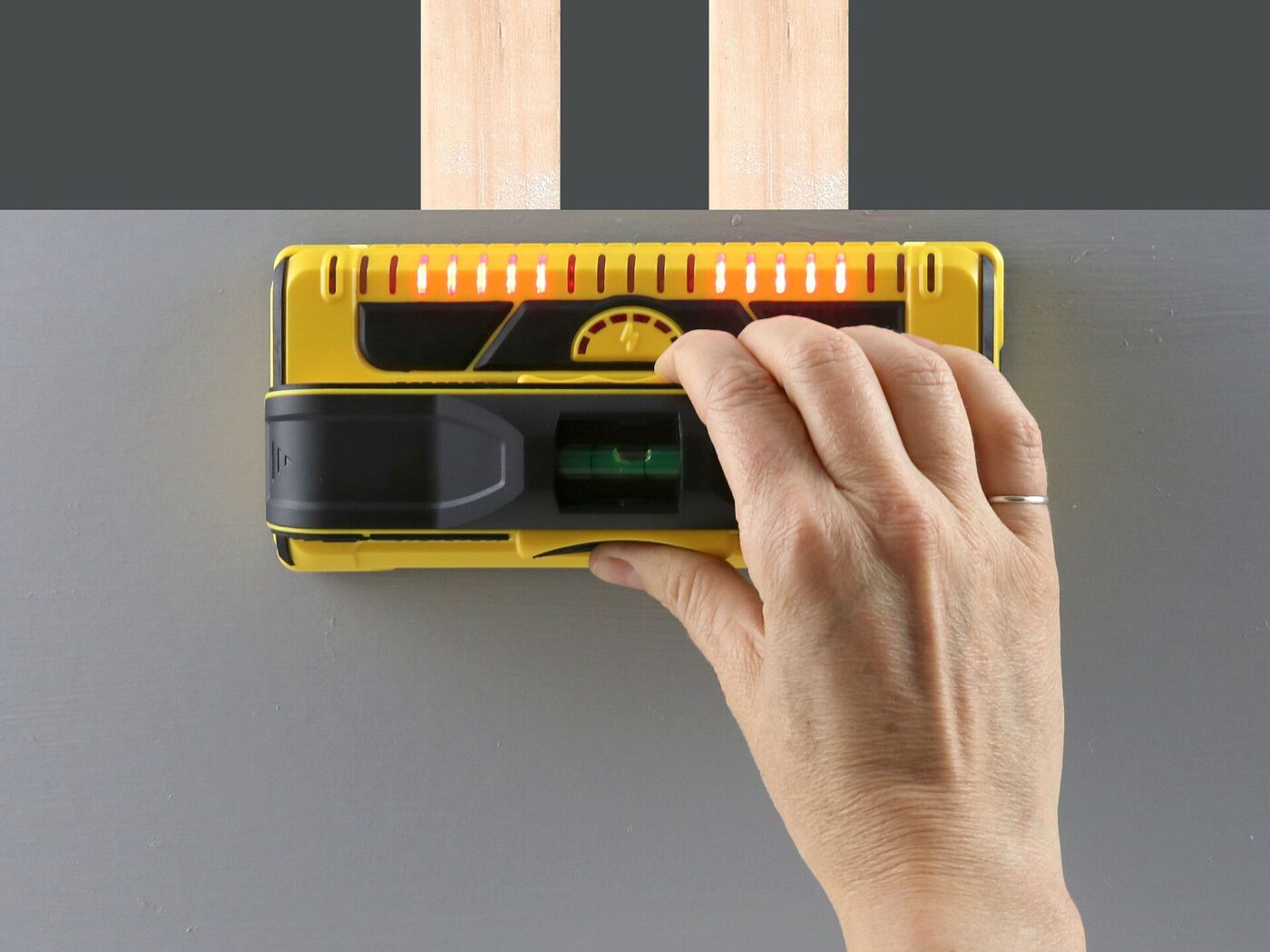
An electronic stud finder is a capacitance sensor. It measures the dielectric constant of whatever sits behind the surface and flags where that changes.
Wood is denser than air, so a stud produces a change. So does a copper pipe, a cable bundle, a lump of insulation, a patch of adhesive or the join between two boards. The device beeps identically for all of them.
Fear Index · Think twice
A confident beep about an ambiguous reading
The instrument is not lying. It reports a density change, and the user reads that as a stud — sometimes when it is a live cable.
What the device is actually sensing
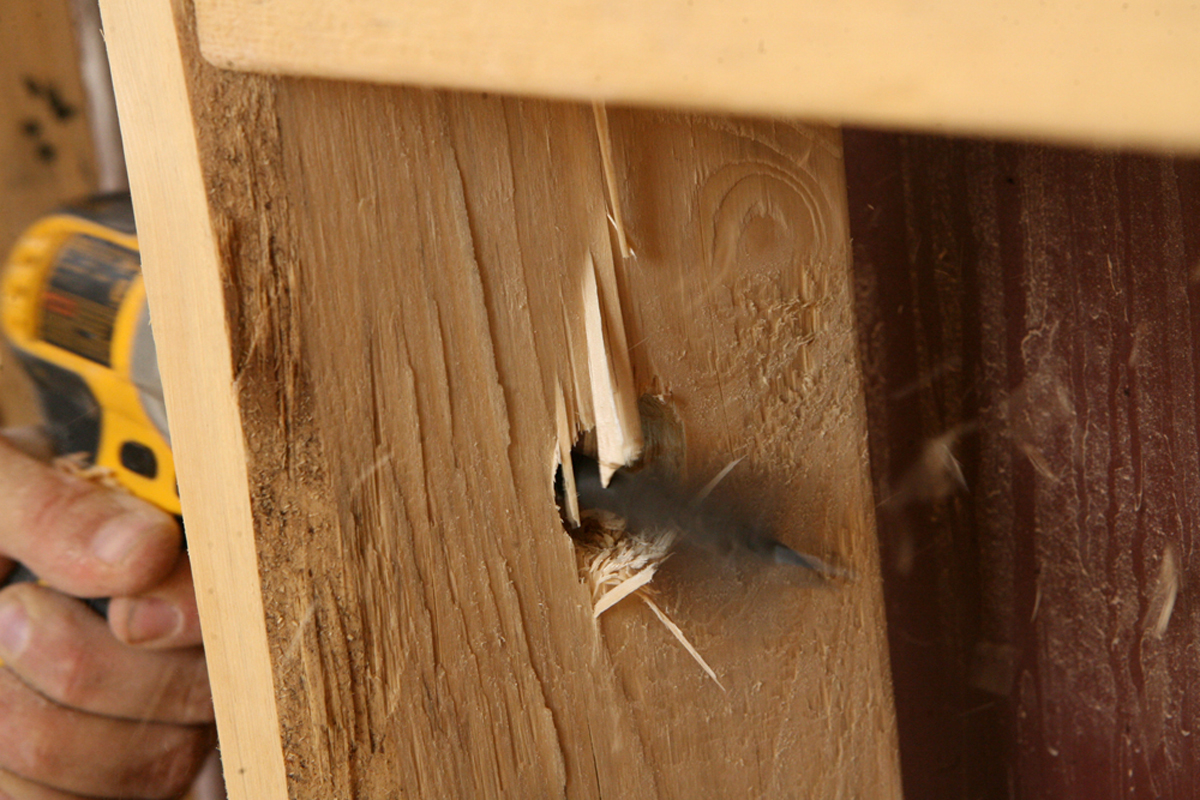
The sensor plate builds an electric field into the wall. Dense material changes the capacitance, and the electronics report the edges of that change.
Consequences follow directly. Calibration happens where you first press the device down — do that over a stud and it calibrates the stud as “empty” and finds the cavities instead. Textured surfaces, thick paint and wallpaper all shift the baseline. Damp plaster reads as continuously dense.
Two readings the same distance apart across a wall are more trustworthy than one. Studs are regularly spaced — usually 16 or 24 inches, or 400/600 mm — so a reading that does not fit the pattern deserves suspicion.
The magnet method is more reliable
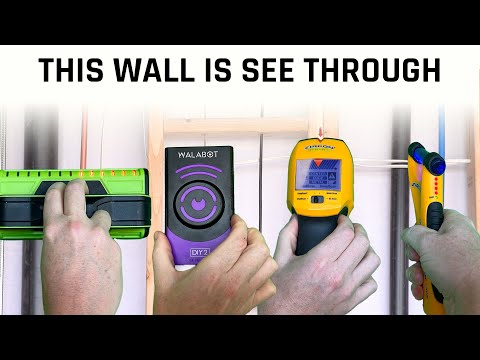
Drywall is fastened to studs with screws or nails, at intervals, all the way up. A strong rare-earth magnet dragged across the wall finds them, and metal fasteners in a line are far better evidence of a stud than a density change.
It is slower and much harder to fool, though it also finds nail plates, corner bead and, in old plaster walls, lath nails everywhere. A small neodymium magnet on a string or in a plastic housing costs very little and has no batteries and no calibration.
Once you have found two fasteners vertically in line, you have almost certainly found a stud, with the fasteners running roughly along its center. One exception matters: a larger patch of metal at a single height may be a steel nail plate, fitted because a cable or pipe passes through the stud behind it. Do not drill there.
Cables and pipes are the real hazard
UK wiring rules define safe zones for cables, but US walls have none. In US homes, cables commonly run horizontally through the studs between outlets and switches, often near outlet height, and vertically to switches and ceiling boxes. The National Electrical Code keeps them at least 1⅓ inches back from the stud face, or behind a steel plate where that setback is not possible — and either protection can be missing in older work.
Practical rules that prevent most drilling accidents:
- Never drill directly above or below an outlet or switch. That vertical line is the most likely cable route in the wall.
- Use a detector with a live-AC mode and scan separately for metal and for live cable. It only senses energized wires, so switch lights on before scanning.
- Set the drill depth stop to the length of the fastener and no deeper. Code keeps cables at least 1⅓ inches back from the stud face, so a shallow hole is the safer hole.
- Turn off the circuit at the breaker before drilling near outlets or switches if you are unsure — a cable stapled inside a stud cannot move out of the way of a bit.
- Assume nothing about old wiring, which may not follow current code setbacks at all.
Look inside the box before you guess
An outlet or switch box tells you more than any scanner, and it costs nothing to check. With the circuit off at the breaker, remove the cover plate and look at which side of the box the cable enters — that tells you which way it likely runs inside the wall, up, down or sideways to the next box, before you drill anywhere near it.
This does not replace scanning or the setback rule; it adds a data point. A cable that clearly enters from below is unlikely to also run upward past the box to a spot you want to drill above it, though “unlikely” is not “never” in a house that has been rewired more than once.
Combine what the box shows with the 1⅓-inch setback rule and a magnet or scan, rather than trusting any single method alone.
The shortlist
Paid links: we earn a commission if you buy through the buttons below, at no extra cost to you. As an Amazon Associate I earn from qualifying purchases.
Compared on what they can and cannot detect
| Product type | Best for | Risk estimate | Where to buy |
|---|---|---|---|
| Magnetic Stud Finder | Finding fasteners reliably | 14/100 | See listings on AmazonOpens Amazon search results, not one listing: check the model on the product page. |
| Multi-Scanner with Live AC Detection | Avoiding cables | 42/100 | See listings on AmazonOpens Amazon search results, not one listing: check the model on the product page. |
| Drill Bit Depth Stop Collars | Limiting drilling depth | 10/100 | See listings on AmazonOpens Amazon search results, not one listing: check the model on the product page. |
Risk estimate is our editorial Fear Index for the product type (lower is safer), not a customer rating. How it is scored.
Magnetic Stud Finder
Two fasteners vertically in line is real evidence. That is more than any capacitive reading gives you.
- Finds real fasteners, not density changes
- No batteries or calibration
- Unaffected by insulation or damp behind the surface
- Slower than an electronic scan
- Also responds to nail plates, not just studs
Multi-Scanner with Live AC Detection
Buy it for the live-wire mode rather than the stud mode. That is the function that prevents the expensive mistake.
- Separate modes for metal and live AC
- Deep scan for masonry
- Faster across a large wall
- Still reports density, not identity
- Needs recalibrating on each surface
More: Tools & DIY analyses and how the Fear Index is scored.
Questions people actually ask
Why does my stud finder beep everywhere?
It detects density changes rather than wood. Pipes, cables, insulation, adhesive and board joins all register. Textured surfaces and damp plaster shift the baseline as well.
Are magnetic stud finders better?
More reliable, because they locate the actual screws or nails fastening the board to the stud. Two fasteners vertically in line is far stronger evidence than a capacitive reading, though a lone patch of metal can also be a nail plate over a cable.
How do I avoid drilling into a cable?
Never drill directly above or below an outlet or switch, use a detector with a live-AC mode, and set a depth stop so the bit goes no deeper than the fastener needs.
How far apart are wall studs?
Usually 16 or 24 inches in the US, or 400 or 600 mm elsewhere. A reading that does not fit the regular spacing is probably not a stud.