
A $35 Radio License Covers a Family on GMRS; Ham Radio Asks for an Exam Instead
GMRS needs a $35 family license, no exam; ham radio needs a passed exam instead. What each license covers, and why some cheap radios are legal for neither.

Part of the guide: Tech and Audio Buying Mistakes: What Fails and How to Check Before You Buy
Three radio services share the same shelf at a big-box store, and an inexpensive handheld can be built to transmit across all three of their frequency ranges. What is legal to actually key up on any given radio depends entirely on which license, if any, the operator holds.
FRS needs no individual license but caps power and antenna design. GMRS needs a license, currently $35, with no exam required. Amateur radio needs a passed exam and a callsign, and in exchange opens far more spectrum than either of the other two.
Fear Index · Think twice
A radio capable of more than its license allows
The FCC bans operating a transmitter that is not certified for the service it is used on, and it has specifically prohibited manufacturing, importing or selling any radio built to work on both GMRS and FRS since September 30, 2019.
FRS, GMRS and amateur radio: who needs a license to transmit
FCC rules for personal radio services set individual licensing as the exception, not the default: a license is required only where a service’s own rules specifically say so. GMRS is one of the services that says so — 47 CFR 95.1705 requires an individual GMRS license — while FRS has no equivalent licensing section in its own subpart of the rules.
Amateur radio sits in a different part of the FCC’s rules entirely, under Part 97, and has required a passed examination since long before GMRS or FRS existed in their current form. It is the only one of the three built around a tested body of operating knowledge rather than a flat fee or none at all.
GMRS: a family license without an exam
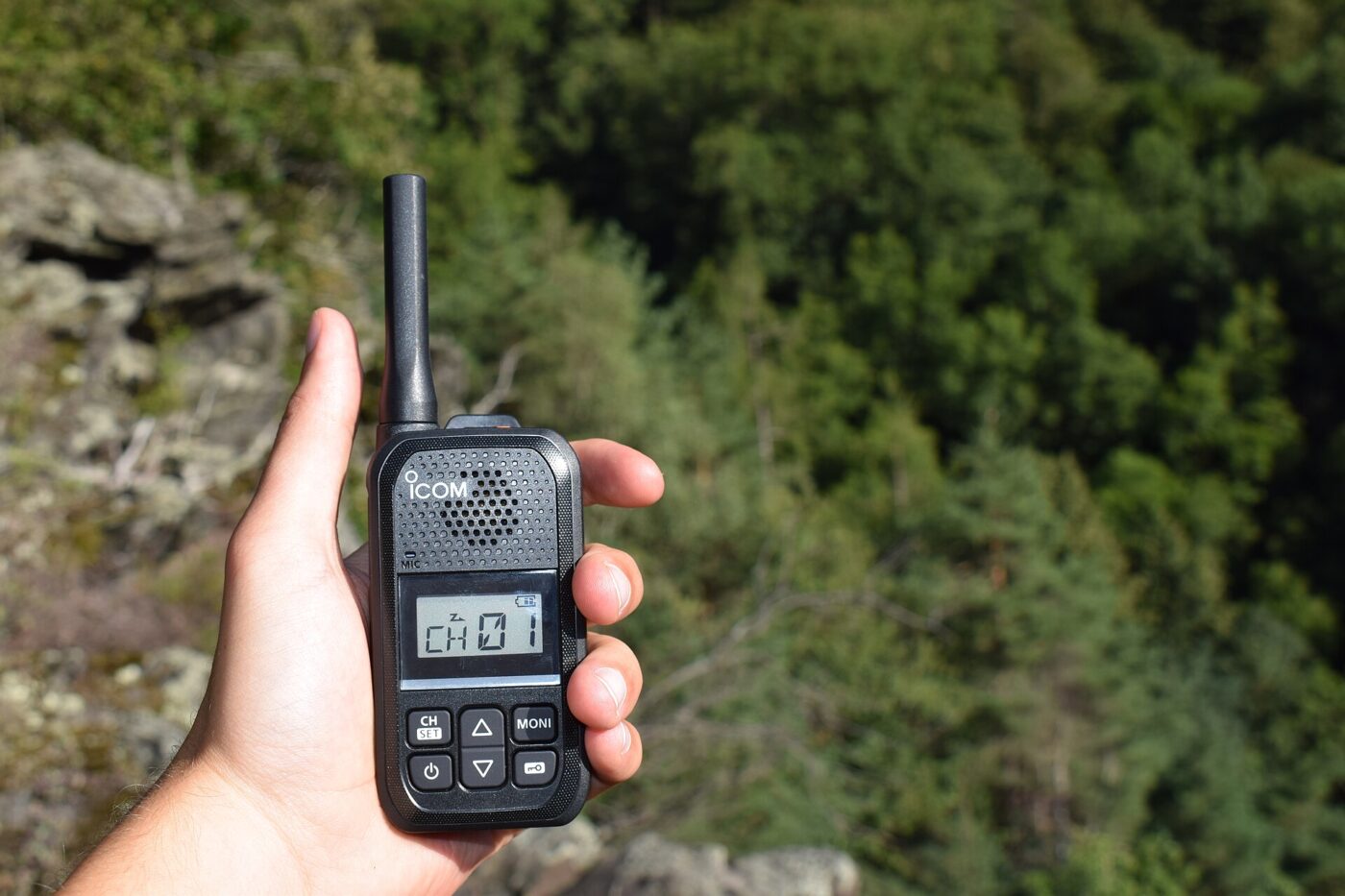
Under 47 CFR 95.1705, any individual at least 18 years old can apply for a GMRS license without taking a test. FCC’s fee schedule at 47 CFR 1.1102 lists the current application fee for a new GMRS license at $35, and Part 1’s general licensing rules cap most FCC wireless authorizations, GMRS included, at up to ten years before renewal.
One license covers more than the person who applied for it. The same rule allows a GMRS licensee to let immediate family members operate under that license, defined broadly to include a spouse, children, parents, siblings and in-laws, without each of them holding a separate license.
Amateur radio: what the exam unlocks

ARRL, the national association for amateur radio, describes a three-class structure that builds on itself. The Technician class, the entry point for most new operators, requires passing a 35-question exam on theory, regulations and operating practices, and unlocks all amateur frequencies above 30 MHz along with some limited HF privileges.
The General class adds a second 35-question exam and opens privileges on every amateur band and mode, described by ARRL as the door to worldwide communication. Amateur Extra, the highest class, requires a 50-question exam on top of the first two and grants every operating privilege the FCC allows. A license earned this way is valid for ten years, the same term as GMRS, but every operator needs their own passed exam and callsign; there is no family-license equivalent.
GMRS trades an exam for narrower privileges shared across a household; amateur radio asks for the exam and grants privileges to the person who passed it.
Why some cheap multi-band radios are not legal to use
FCC rules prohibit operating any transmitter in the personal radio services that is not certified for the specific service it is being used on, under 47 CFR 95.335, and separately prohibit manufacturing, importing or selling non-certified equipment for those services under 47 CFR 95.391. A radio built to transmit across GMRS, FRS and amateur frequencies is not automatically certified for all of them just because it can reach those frequencies.
The FCC has gone further for one specific combination: 47 CFR 95.1791 has banned manufacturing, importing or selling any radio capable of operating on both GMRS and FRS since September 30, 2019. An inexpensive imported handheld marketed as covering FRS, GMRS and amateur bands in one unit is exactly the design that rule was written to stop.
Range, repeaters and what to expect in an emergency
GMRS is allocated 30 channels across the 462 and 467 MHz bands under 47 CFR 95.1763, and several of the 462 MHz main channels can be used with repeater stations, which extend a handheld’s practical range well beyond simple radio-to-radio distance. FRS radios, without an individual license or repeater access, are built for shorter, direct communication instead.
Amateur radio adds the most range of the three, both through its wider allocation of frequencies and an established network of repeaters and emergency nets, but every one of those capabilities sits behind the exam. For a household building an emergency plan, the honest comparison is not which radio is cheapest, but which license the people using it are actually willing to get.
The shortlist
Paid links: we earn a commission if you buy through the buttons below, at no extra cost to you. As an Amazon Associate I earn from qualifying purchases.
Compared on what license each radio needs
| Product type | Best for | Risk estimate | Where to buy |
|---|---|---|---|
| FCC Part 95 Certified GMRS Handheld Radio | A GMRS family license | 20/100 | See listings on AmazonOpens Amazon search results, not one listing: check the model on the product page. |
| License-Free FRS Walkie-Talkies (Pair) | No license at all | 15/100 | See listings on AmazonOpens Amazon search results, not one listing: check the model on the product page. |
| Dual-Band VHF/UHF Amateur Handheld (License Required) | Full amateur privileges | 25/100 | See listings on AmazonOpens Amazon search results, not one listing: check the model on the product page. |
Risk estimate is our editorial Fear Index for the product type (lower is safer), not a customer rating. How it is scored.
FCC Part 95 Certified GMRS Handheld Radio
A GMRS license costs $35 and covers the licensee’s immediate family with no exam, under FCC’s fee schedule and station rules.
- Certified for GMRS use under Part 95
- One $35 license covers immediate family
- Can use repeater channels for added range
- Still requires an individual license, unlike FRS
- Limited to GMRS-allocated channels
Dual-Band VHF/UHF Amateur Handheld (License Required)
Amateur radio opens more spectrum than GMRS, but each operator needs their own passed exam and callsign rather than a shared household license.
- Full amateur privileges once the exam is passed
- Access to amateur bands GMRS cannot use
- No family-coverage limit on who can hold a license
- Requires passing a written exam first
- Callsign identification required on air
More: Emergency Prep and Power analyses and how the Fear Index is scored.
Sources
- 47 CFR 95.1705, GMRS Individual Licenses; Eligibility; Who May Operate — Cornell Law School
- 47 CFR 1.1102, Schedule of Charges (Wireless Telecommunications) — Cornell Law School
- 47 CFR 95.1791, Sales of GMRS/FRS Combination Radios Prohibited — Cornell Law School
- 47 CFR 95.335, Operation of Non-Certified Transmitters Prohibited — Cornell Law School
- Getting Licensed — ARRL, the National Association for Amateur Radio
Questions people actually ask
Do I need a license to use a GMRS radio?
Yes. Under 47 CFR 95.1705, an individual must hold a GMRS license, currently $35 under FCC’s fee schedule, though no exam is required and the license covers the licensee’s immediate family.
Do FRS walkie-talkies require a license?
FCC’s rules do not set out an individual-license requirement for FRS the way they do for GMRS. FRS radios instead operate at fixed, lower power with non-removable antennas.
Why are some cheap imported radios not legal for GMRS or FRS?
FCC rules ban operating a non-certified transmitter and ban manufacturing, importing or selling non-certified equipment for personal radio services, and specifically prohibit radios built to work on both GMRS and FRS.
What does an amateur radio license require that GMRS does not?
A passed written exam. ARRL describes three exam-based classes — Technician, General and Amateur Extra — each unlocking more frequencies and modes, compared with GMRS’s no-exam family license.
Can GMRS radios use repeaters?
Yes, on several of the 462 MHz main channels under 47 CFR 95.1763, which is how GMRS extends its practical range beyond simple handheld-to-handheld distance.