
The Ladder Rating Includes You, Your Tools and What You Are Carrying
A 250 lb ladder rating covers your body weight plus clothing, tools and materials. Most buyers count only themselves. What each ANSI type means.

Part of the guide: Tools and DIY Buying Mistakes: What Fails and How to Check Before You Buy
Ladders carry a duty rating — a maximum load in pounds. It is easy to read it as a weight limit for the person and conclude that a 200 lb rating is generous.
It is not a personal weight limit. It is the total the ladder is engineered to carry, and everything you take up counts.
Fear Index · High risk
A load limit that people read as a body-weight limit
Falls from height are among the most common serious DIY injuries, and overloading is only one of several routine errors.
What the number actually covers
The rating includes your body weight, your clothing and boots, any tool belt, the tool in your hand and whatever material you are carrying.
| Type | Duty rating | Intended use |
|---|---|---|
| Type III | 200 lb | Light household |
| Type II | 225 lb | Light commercial |
| Type I | 250 lb | Industrial |
| Type IA | 300 lb | Extra heavy duty |
| Type IAA | 375 lb | Special duty |
A 180 lb person in work boots with a loaded tool belt and a bucket of tile can reach or pass 250 lb. Buy Type IA and stop doing arithmetic on a ladder.
The angle rule, and the three-point rule

Two conventions prevent a large share of ladder accidents, and both are easy to remember.
- The 4-to-1 rule. For every four feet of height to the contact point, place the base one foot out. That gives roughly 75°. Too steep and it tips backwards; too shallow and the base slides out.
- Three feet above the landing. An extension ladder used to reach a roof or platform must project about three feet past it, so there is something to hold while stepping across.
- Three points of contact, always — two feet and a hand, or two hands and a foot. That means carrying tools on a belt, not in a hand.
- Belt buckle inside the rails. The moment you reach past that, the ladder is being asked to resist a sideways force it was not designed for.
- Level, firm ground. Ladder levelers exist for a reason; a brick under one foot does not count as one.
- On a stepladder, never stand on the top cap or the step below it, and never lean a folded stepladder against a wall to climb it.
Material, and where it matters
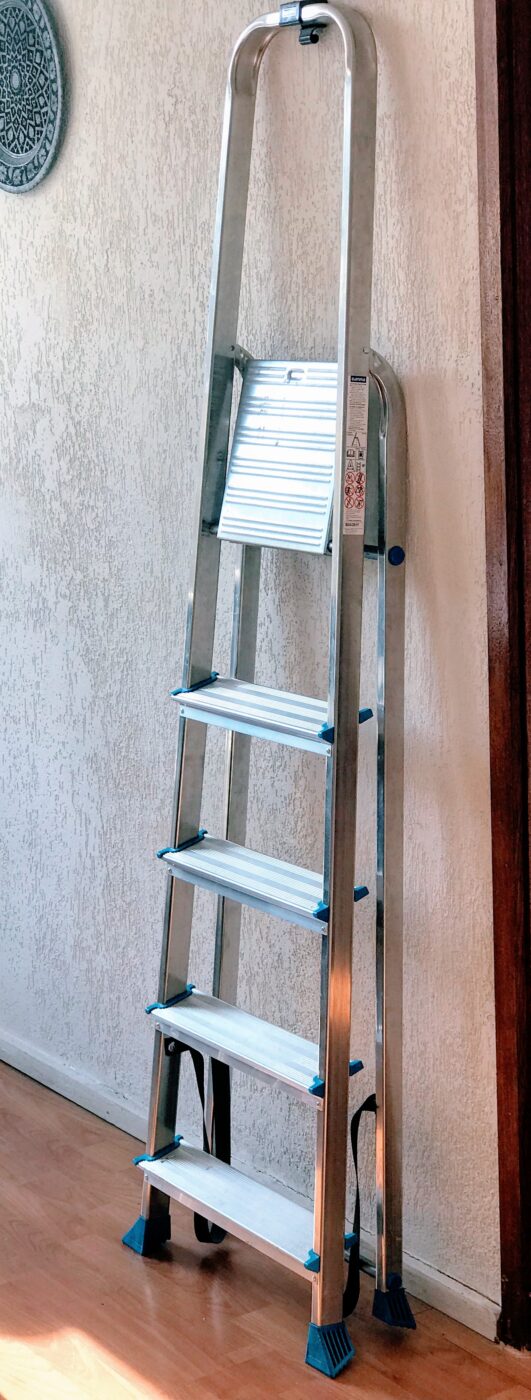
Aluminum is light, stiff and conducts electricity. Near any overhead line or live work, it is the wrong choice and the consequences are not recoverable.
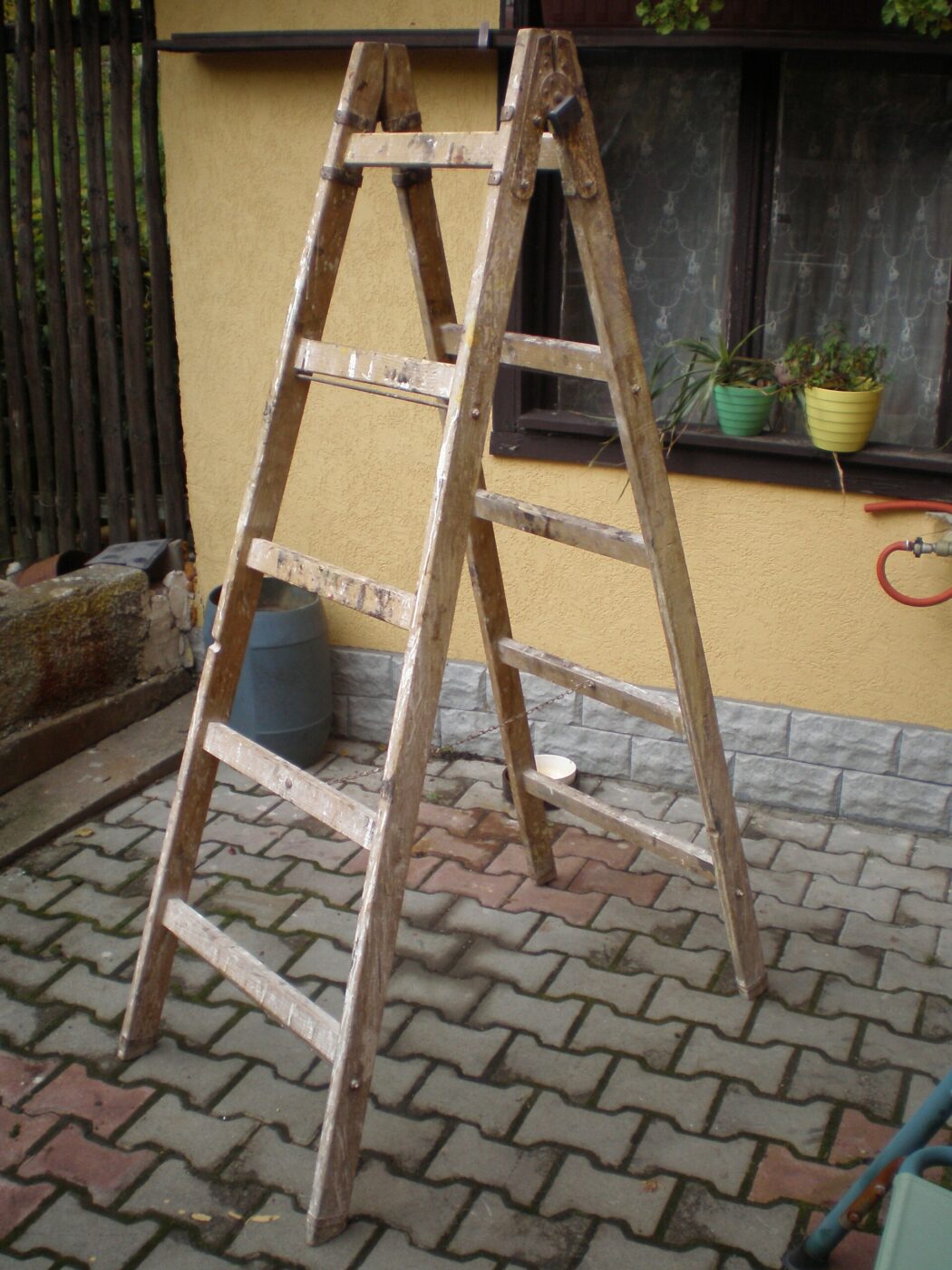
Fiberglass is heavier and does not conduct when clean and dry, which makes it the right choice for electrical work. It is not protection from power lines: wet or dirty fiberglass can conduct, and no ladder material makes contact with a live line safe. Keep any ladder, and yourself, at least 10 feet from overhead lines and the service drop — that clearance is the actual safety measure, not the rail material.
For general household use aluminum is fine and much easier to carry. Be honest about whether any of your jobs involve wiring.
Inspect before every use, not just at purchase
A duty rating and a straight climb up the driveway do not tell you the ladder is still sound. The American Ladder Institute publishes a pre-use checklist for exactly this reason, and the items on it take less time to run through than setting the ladder up.
- Rails and rungs, checked for cracks, bends or splinters. On fiberglass, hairline cracks in the resin are the failure to watch for.
- Spreader bars and locks, confirmed fully engaged before you climb, not just resting closed.
- Feet, checked for wear, mud or grease that would let the base slide.
- The duty-rating label itself, still legible. A ladder that has been repainted or sanded can lose the only record of what it is rated for.
A ladder that fails any of these should be tagged and retired, not used carefully. There is no safe way to compensate for a cracked rail.
The shortlist
Paid links: we earn a commission if you buy through the buttons below, at no extra cost to you. As an Amazon Associate I earn from qualifying purchases.
Compared on duty rating and real use
| Product type | Best for | Risk estimate | Where to buy |
|---|---|---|---|
| Type IA Step Ladder (300 lb) | Household jobs | 32/100 | See listings on AmazonOpens Amazon search results, not one listing: check the model on the product page. |
| Extension Ladder, 24 ft | Heavy or trade use | 44/100 | See listings on AmazonOpens Amazon search results, not one listing: check the model on the product page. |
| Three-Step Stool with Handrail | Indoor work at low height | 20/100 | See listings on AmazonOpens Amazon search results, not one listing: check the model on the product page. |
Risk estimate is our editorial Fear Index for the product type (lower is safer), not a customer rating. How it is scored.
Type IA Step Ladder (300 lb)
The rating people should buy rather than the one they calculate they need. The margin is the point.
- 300 lb rating leaves real margin
- Fiberglass rails are non-conductive when clean and dry
- Wide steps are comfortable to stand on
- Heavier than aluminum
- Bulky to store
Three-Step Stool with Handrail
A great many household falls happen on chairs and worktops. A proper stool removes the temptation.
- Handrail gives a genuine third contact point
- Folds into a cupboard
- No setup angle to get wrong
- Limited height
- Not for outdoor or uneven ground
More: Tools & DIY analyses and how the Fear Index is scored.
Questions people actually ask
What does a ladder duty rating include?
Your body weight plus clothing, boots, tool belt, tools and any materials you carry. It is a total load rating, not a personal weight limit.
What angle should an extension ladder be set at?
Roughly 75°, achieved with the 4-to-1 rule: the base one foot out from the wall for every four feet of height to the contact point.
Should I buy an aluminum or fiberglass ladder?
Fiberglass for any electrical work, because aluminum conducts. No ladder makes contact with an overhead line safe, so keep any ladder at least 10 feet from power lines regardless of material. Aluminum is fine and lighter for general household use.
How far should a ladder extend above a roof?
About three feet past the landing point, so there is something solid to hold while stepping on and off.