
A Suitcase Record Player Tracks Far Heavier Than a Budget Turntable, and the Grooves Pay
A suitcase player’s fixed arm cannot be adjusted to a modern cartridge’s spec. What tracking force actually is, and how heavy tracking wears out records.

On this page 6 sections
- What tracking force is, and why grooves pay for too much of it
- Ceramic cartridges and a fixed arm: what a suitcase player cannot adjust
- A budget turntable with a counterweight changes the equation
- Stylus wear and when to replace it
- Cleaning and storing records so the stylus is not fighting dust too
- The shortlist
Part of the guide: Tech and Audio Buying Mistakes: What Fails and How to Check Before You Buy
A suitcase record player looks like a smaller, cheaper version of a real turntable: a platter, a tonearm, a needle, a lid that closes into a carrying handle. Mechanically, the part that matters most is not smaller at all.
A modern hi-fi cartridge is built to track a groove at a specific, light downward pressure. A suitcase player’s arm has no way to be set to that number, because it has no counterweight to set in the first place — and the gap between what it delivers and what a cartridge is built for is where a record collection actually takes the damage.
Fear Index · Think twice
A cheap deck that wears out the collection it plays
A cartridge specified for around two grams of tracking force is engineered around that number; a fixed tonearm with no counterweight cannot be dialed down to match it.
What tracking force is, and why grooves pay for too much of it
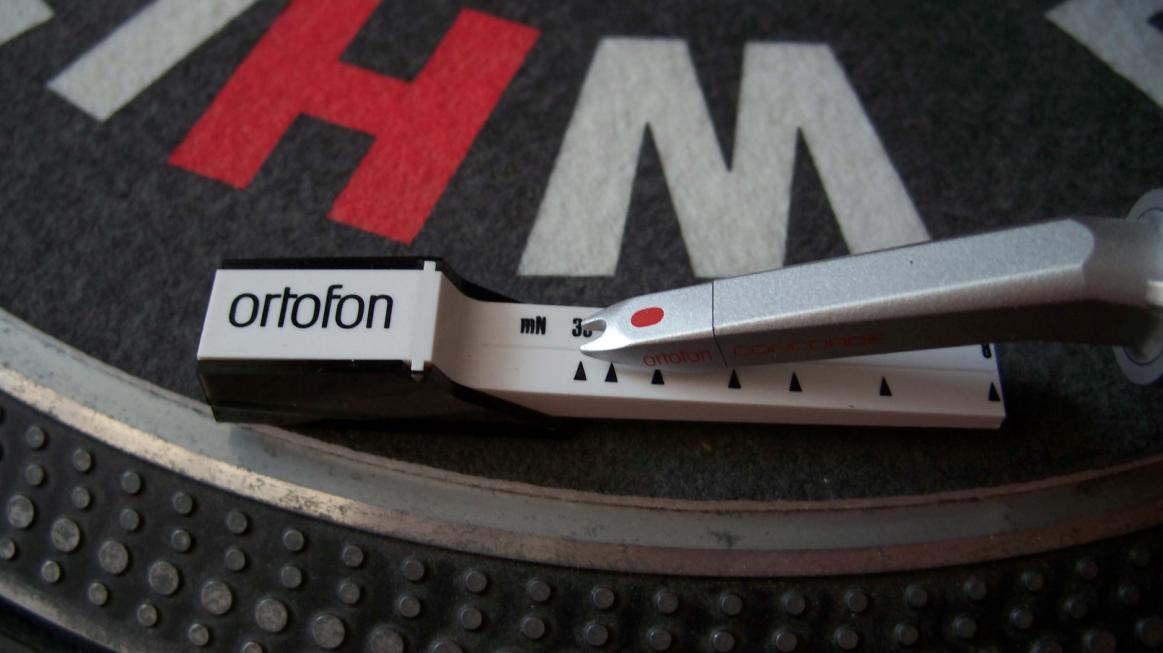
Tracking force is, in Ortofon’s own description, “the downward pressure that is applied by the weight of the tonearm through the cartridge stylus and onto the vinyl record.” Every cartridge is designed around a specific range of that pressure, and the manufacturer publishes it as a spec, not a suggestion.
Ortofon’s 2M Red, a common entry-level hi-fi cartridge, is specified at 1.6 to 2.0 grams of tracking force. That is the range the stylus, the cantilever and the groove contact are all engineered to work within, and Ortofon is direct about why hitting it matters: “it is important to set the proper tracking force in order to maximize the playback performance and to reduce the risk of mistracking or causing excessive record wear.”
Both directions of error cost something. Too little force lets the stylus skip and bounce instead of tracing the groove cleanly, which mistracks and can chip the groove wall on loud passages. Too much force presses the stylus harder into the same groove wall on every single pass, and friction on vinyl means material coming off that wall a little at a time.
A cartridge specified for two grams is engineered around that number. More force does not mean more contact; it means more friction on the same groove wall.
Ceramic cartridges and a fixed arm: what a suitcase player cannot adjust
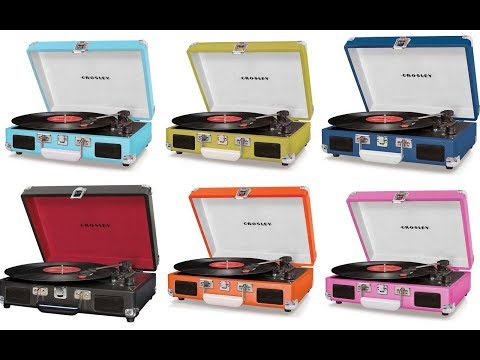
Most inexpensive all-in-one suitcase players use a ceramic (piezoelectric) cartridge mounted on a simple, non-detachable tonearm. The arm has no counterweight to slide and no dial to set, which means whatever downward pressure the arm delivers at the factory is the only pressure it will ever deliver.
That fixed pressure was never designed to land in the 1.6-to-2.0-gram range a cartridge like the 2M Red is built for. Ceramic cartridges are built to a different, heavier-tracking design in the first place, which is part of why they were common in inexpensive all-in-one players for decades: they tolerate the higher, unadjustable force a simple arm applies. The record does not get that same tolerance.
There is no anti-skate adjustment either, so the pressure is not just heavier than a modern cartridge’s spec, it is also less evenly distributed across the two groove walls the stylus is supposed to be reading at once.
Nothing about a fixed arm is adjustable, which means nothing about its tracking force is tuned to the record it is playing.
A budget turntable with a counterweight changes the equation
A turntable with a real counterweight and an anti-skate dial lets an owner set tracking force to whatever the mounted cartridge is specified for, instead of inheriting whatever an arm happens to weigh. That single feature is the practical difference between a deck that can be tuned to a cartridge’s spec sheet and one that cannot.
A digital stylus force gauge, set under the stylus with the arm lowered as if playing a record, confirms the counterweight is actually at the number the dial claims rather than just approximately right by eye. It is a five-minute check worth doing once after any cartridge change, not a recurring chore.
A counterweight is not a luxury feature. It is the part that lets tracking force match the cartridge instead of the arm’s default heft.
Stylus wear and when to replace it
A worn stylus and a heavily tracked record wear each other out together. Ortofon lists the audible signs of a worn stylus plainly: “increased surface noise or distortion, a loss of high-frequency detail, or a general lack of clarity in the sound,” often most noticeable on strings and voices toward a record’s inner grooves.
Ortofon does not tie replacement to one fixed hour count; its own guidance ties the right interval to how often the cartridge is used, the size of the collection being played, and how well the records themselves are kept clean, rather than a single number that applies to every setup.
Cleaning and storing records so the stylus is not fighting dust too
The National Archives’ guidance on audio storage recommends shelving discs “vertically and in their sleeves” rather than stacking them flat, and keeping the storage area at stable conditions — roughly 55 to 70 degrees Fahrenheit and 30 to 55 percent relative humidity — away from sunlight and off the floor, where flooding, insects or general wear are more likely to reach them.
A clean, dust-free record gives a stylus one less obstacle to plow through on every pass, on any turntable. It does not offset a fixed arm’s excess tracking force, but it removes a second source of groove wear that has nothing to do with the arm at all.
Storage habits do not fix a heavy tracking arm, but a clean, upright record gives whatever stylus is playing it one less thing to fight.
The shortlist
Paid links: we earn a commission if you buy through the buttons below, at no extra cost to you. As an Amazon Associate I earn from qualifying purchases.
Compared on getting tracking force right
| Product type | Best for | Risk estimate | Where to buy |
|---|---|---|---|
| Belt-Drive Turntable With Adjustable Counterweight | Adjustable tracking force | 18/100 | See listings on AmazonOpens Amazon search results, not one listing: check the model on the product page. |
| Digital Stylus Force Gauge | Confirming the number, not guessing | 8/100 | See listings on AmazonOpens Amazon search results, not one listing: check the model on the product page. |
| Anti-Static Carbon Fiber Record Brush | Keeping debris out of the groove | 6/100 | See listings on AmazonOpens Amazon search results, not one listing: check the model on the product page. |
Risk estimate is our editorial Fear Index for the product type (lower is safer), not a customer rating. How it is scored.
Belt-Drive Turntable With Adjustable Counterweight
An adjustable counterweight lets tracking force be set to the cartridge’s own spec sheet instead of whatever a fixed arm happens to weigh.
- Counterweight and anti-skate both adjustable
- Works with standard replaceable cartridges
- Costs more than an all-in-one suitcase player
- Needs a separate amp or powered speakers
Digital Stylus Force Gauge
A digital gauge confirms a counterweight is actually set where the dial claims, rather than trusting a scale printed on the tonearm.
- Reads tracking force directly in grams
- Cheap enough to check after every cartridge swap
- One more accessory to store
- Needs a flat surface for an accurate reading
Anti-Static Carbon Fiber Record Brush
A quick brush before each play keeps loose dust from being ground into the groove by whatever tracking force is set on the arm.
- Removes loose dust before the stylus does
- Anti-static fibers cut down on crackle
- Will not remove ground-in grime
- Not a substitute for a wet cleaning
More: Music and Instruments analyses and how the Fear Index is scored.
Questions people actually ask
Do suitcase record players really damage records?
A fixed tonearm with no counterweight cannot be adjusted down to the light tracking force a modern cartridge is specified for, and Ortofon’s own guidance says too much force wears out the stylus and record grooves faster than the correct setting does.
What tracking force should a turntable use?
It depends on the cartridge. Ortofon specifies 1.6 to 2.0 grams for its 2M Red, a typical entry-level hi-fi cartridge, and a counterweight lets that number be set exactly rather than approximated.
How do I know when to replace a turntable stylus?
Increased surface noise, distortion or a loss of high-frequency detail are signs of stylus wear, per Ortofon, and replacement timing depends more on how often it is used and how clean the records are than on a single fixed hour count.
How should vinyl records be stored?
The National Archives recommends shelving records vertically in their sleeves, never stacked flat, kept off the floor, in stable conditions around 55 to 70 degrees Fahrenheit and 30 to 55 percent relative humidity.
Can a suitcase player’s cartridge be upgraded?
Most use a fixed arm and a ceramic cartridge that is not built for a swap the way a standard mounted cartridge on a belt-drive turntable is, which is why the arm itself is usually the real limitation, not just the stylus.